
Sleep health education
Sleep Hygiene: 15 Habits for Better Sleep

Quick answer
Sleep hygiene means the routines, timing cues and bedroom conditions that support sleep. The highest-value starting points are allowing enough time for sleep, keeping wake time reasonably consistent, getting daytime light and activity, and reducing things that delay or fragment sleep. These habits support healthy sleep, but they are not a stand-alone treatment for chronic insomnia, sleep apnea or another sleep disorder.
Timing choices that can affect sleep
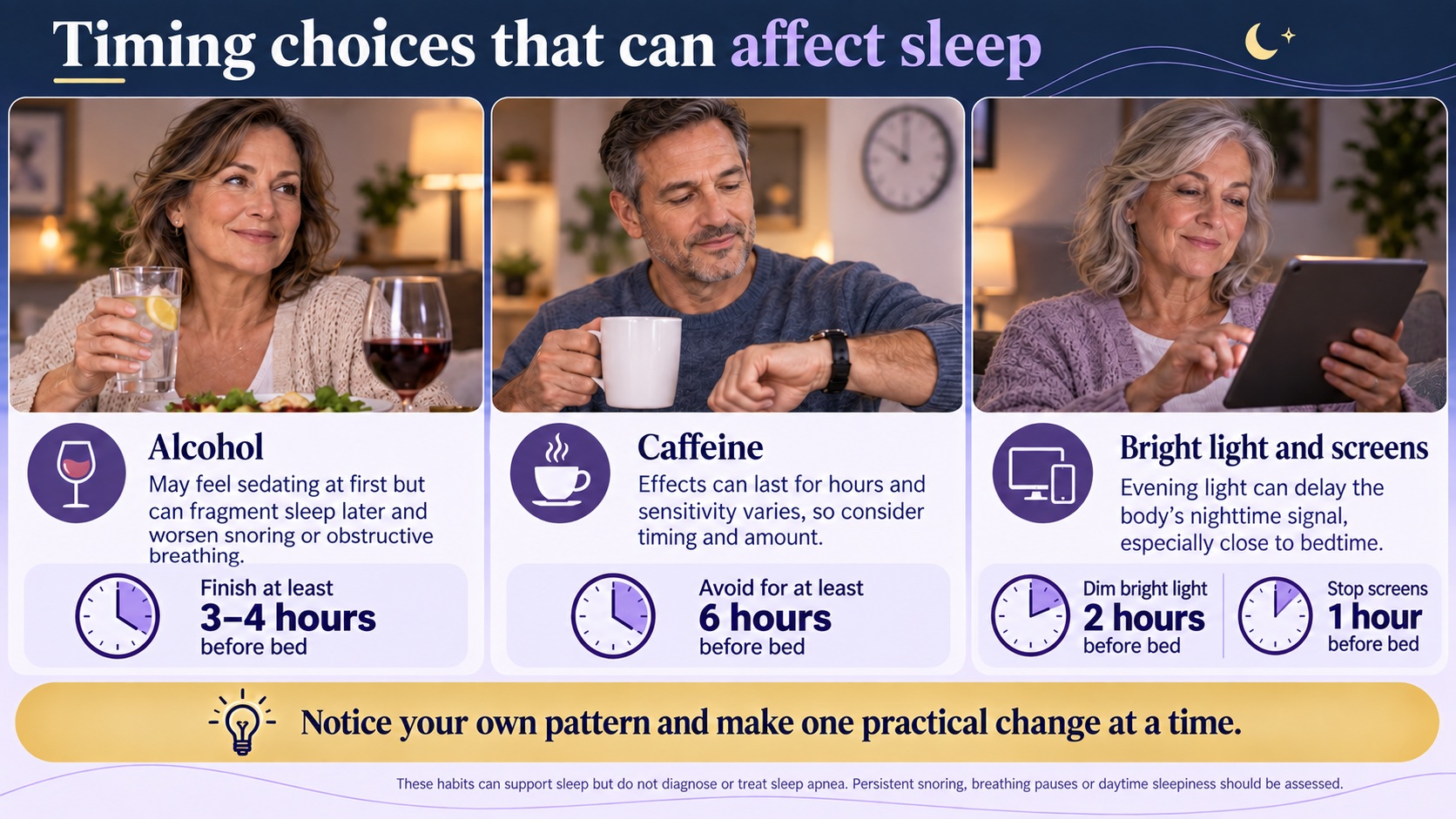
- Finish alcohol at least 3–4 hours before bed.
- Avoid caffeine for at least 6 hours before bed.
- Dim bright light 2 hours before bed and stop screens 1 hour before bed.
- These habits support sleep but do not diagnose or treat sleep apnea.
What sleep hygiene can—and cannot—do
Sleep hygiene is a foundation, not a test of discipline. It can reduce avoidable barriers to sleep and make patterns easier to recognize. It may be enough when the main problem is an inconsistent schedule, late caffeine, a stimulating evening routine or an uncomfortable bedroom.
It does not diagnose the cause of poor sleep. The American Academy of Sleep Medicine recommends against using sleep hygiene as the only treatment for chronic insomnia; multicomponent cognitive behavioural therapy for insomnia (CBT-I) has stronger evidence. Sleep hygiene also cannot open an obstructed airway, correct an underlying circadian disorder, treat restless legs syndrome or replace adequate sleep opportunity.
How to use these 15 habits
Start with the habit most clearly connected to your pattern. If bedtime varies by several hours, begin with timing. If you routinely sleep five hours because of work or caregiving, protect sleep opportunity before buying blackout curtains. If you are sleepy despite adequate time in bed, look beyond routine alone.
Track a small number of changes for about two weeks. Note bedtime, estimated sleep time, awakenings, wake time, naps, caffeine and daytime function. One difficult night does not prove that a strategy failed, and one good night does not prove that it solved the problem.
1. Protect enough time for sleep
Work backward from the time you must wake and reserve a realistic sleep opportunity. Most adults need at least seven hours of sleep regularly, and individual need varies. Time in bed is not identical to time asleep, so the available window usually needs to be longer than the sleep duration you are aiming for.
If work, caregiving, pain, housing or another constraint makes enough sleep difficult, treat that as a real barrier—not a personal failure. A perfect routine cannot compensate for repeatedly allowing too little time. See How Much Sleep Do You Need? for age-based context and a way to estimate your own need.
2. Keep wake time reasonably consistent
Wake time is a strong daily timing cue. Keeping it within a reasonably consistent range—including days off—can make sleepiness arrive more predictably at night. Large weekend shifts may feel like recovery but can also make the next schedule change harder.
Consistency does not mean ignoring illness, an unusually short night or shift-work realities. Aim for a workable pattern rather than minute-by-minute perfection. People with rotating or overnight schedules need a plan built around their actual shifts; review Shift Work and Sleep.
3. Use morning and daytime light
Light helps set the body clock. For many people on a daytime schedule, outdoor light after waking supports alertness and reinforces the timing of the sleep-wake cycle. Outdoor light is generally brighter than ordinary indoor light, even on a cloudy day.
The useful timing depends on the schedule and circadian pattern. Bright light at the wrong time can shift sleep later or earlier, and treatment-level light boxes need additional care for some eye conditions, medicines and mood disorders. Learn more in Circadian Rhythm: Understanding Your Body Clock.
4. Be active during the day
Regular physical activity supports general health and can improve sleep quality. A sustainable pattern across the week is more useful than one exhausting workout performed as a sleep remedy.
Morning activity can pair naturally with daylight, and evening exercise works well for many people. If vigorous late activity repeatedly leaves you hot, activated or unable to fall asleep, move it earlier or reduce the intensity. Use Exercise and Sleep to compare timing and track your response.
5. Move caffeine earlier
Caffeine blocks adenosine signalling and can reduce the feeling of sleep pressure. Effects can persist for hours, and sensitivity varies with dose, timing, pregnancy, medicines, smoking status and individual metabolism.
Count coffee, tea, cola, energy drinks, chocolate, pre-workout products and caffeine-containing medicines. If sleep onset or nighttime waking is a concern, keep the morning amount stable and remove later caffeine for one to two weeks rather than changing several variables at once. See Caffeine and Sleep for a timing experiment.
6. Avoid using alcohol as a sleep aid
Alcohol may shorten the time it takes to fall asleep, but sedation is not the same as restorative sleep. As alcohol is metabolized, sleep may become more fragmented. It can also relax upper-airway tissues and worsen snoring or obstructive breathing in some people.
Avoid relying on alcohol to initiate sleep, and notice whether timing or amount changes awakenings, snoring, reflux or next-day function. Heavy regular use should not be stopped abruptly without medical advice because withdrawal can be dangerous. Read Alcohol and Sleep for safer context and support indicators.
7. Create a repeatable wind-down
Use the period before bed to reduce bright light, unfinished tasks and stimulating content. The goal is a recognizable transition from daytime demands to sleep—not an elaborate ritual that creates more pressure.
A brief routine might include preparing tomorrow’s essentials, lowering the lights, completing personal care and choosing a quiet activity. If the routine is regularly crowded out, make it shorter and easier to repeat. Build one with Bedtime Routine: How to Wind Down for Better Sleep.
8. Keep the bedroom dark enough
Reduce light that is unnecessary during the intended sleep period. Curtains, blinds, an eye mask or covering small indicator lights may help, provided the change remains safe and accessible.
Darkness should not create a fall risk or prevent a person from seeing medical equipment, mobility aids, children or urgent alerts. For daytime sleep after a night shift, light control may need to include the trip home and household planning as well as the bedroom.
9. Reduce disruptive noise
Address predictable sounds where practical: close a door, silence non-urgent notifications, repair a repeating noise or discuss household quiet periods. Earplugs or neutral background sound help some people, but they should not block smoke alarms, medical alarms, a child’s needs or other safety signals.
Snoring is not merely an environmental noise when it includes pauses, choking or gasping. Those observations belong in a sleep-apnea assessment rather than being covered up with louder sound. Compare Snoring vs. Sleep Apnea.
10. Keep the room comfortable
A dark, quiet, well-ventilated and generally cool room is comfortable for many people, but there is no universal perfect temperature. Bedding, hormones, illness, pain, room sharing, humidity and local weather all affect comfort.
Aim for a setting that reduces sweating, shivering, dryness and repeated adjustments. If overheating, night sweats, pain, breathing symptoms or another physical problem repeatedly wakes you, investigate the symptom rather than treating the thermostat as the full explanation.
11. Use the bed mainly for sleep
Spending long, frustrated periods awake in bed can strengthen the association between bed and wakefulness. Keep work, scrolling and emotionally activating tasks out of bed when practical. If you are wide awake and becoming frustrated, a quiet activity in dim light may be more helpful than forcing sleep; return when sleepiness increases, provided getting up is safe for you.
This general principle is not the same as a self-directed sleep-restriction program. Formal stimulus control and sleep restriction are components of CBT-I and should be adapted when fall risk, bipolar disorder, seizure disorders, pregnancy, severe sleepiness or another health concern is present.
12. Avoid large meals close to bedtime
Heavy or highly irritating meals near bedtime can contribute to fullness, reflux or discomfort. If hunger interferes with sleep, a light snack may be reasonable. The useful timing and food choice depend on medical needs, culture, work schedule and personal response.
Do not skip required nutrition or change diabetes, reflux, pregnancy or medication-related eating instructions solely to follow a generic sleep rule. Discuss recurring nighttime reflux, pain, choking or nausea with an appropriate healthcare professional.
13. Manage naps thoughtfully
Naps can support alertness after restricted sleep and may be part of a planned shift-work strategy. Earlier and shorter naps are generally less likely to reduce nighttime sleep pressure than long or late naps, but the right approach depends on why you are napping.
Frequent unintended dozing or an irresistible need to nap despite adequate nighttime sleep is not simply a scheduling problem. Do not drive when struggling to stay awake. Review Napping: Benefits, Timing and When It Disrupts Sleep for a seven-day nap check.
14. Review medicines and substances
Prescription and over-the-counter medicines, nicotine, cannabis, supplements and other substances can affect sleepiness, alertness, breathing, movement or nighttime urination. The same product may be activating for one person and sedating for another, and timing can matter.
Keep an accurate list and discuss possible sleep effects with a prescriber or pharmacist. Do not stop, start or change a prescribed medicine because of a sleep-hygiene list. Seek prompt advice for a concerning reaction, dangerous interaction or substance-withdrawal risk.
15. Seek help when symptoms persist
If a consistent routine and adequate sleep opportunity do not improve the problem, the next step is not necessarily stricter sleep hygiene. Persistent difficulty falling or staying asleep, waking too early, loud snoring, witnessed pauses, gasping, uncomfortable leg sensations, unusual behaviours during sleep or severe daytime sleepiness can point to different problems requiring different care.
Bring a two-week sleep record, medicine and substance list, work schedule and partner observations to the conversation. Review Sleep Apnea Symptoms when breathing or daytime alertness is part of the pattern.
How to build a bedtime routine
A short, repeatable wind-down tells your body that sleep is coming. Keep your wake-up time steady first, then use this flexible 60–30–10 routine and keep only the steps that fit your life.
The exact timing is flexible. Use this as a menu and keep only the steps that fit your life.
A routine supports sleep but does not treat insomnia or sleep apnea. If you still struggle to sleep most nights, see insomnia.
How can I fall asleep faster?
It normally takes about 10 to 20 minutes to fall asleep (Cleveland Clinic). Trying hard to fall asleep usually backfires, so aim to make sleep easier rather than faster:
- Go to bed when you feel sleepy, not just tired, and keep the same wake-up time every day.
- If you cannot fall asleep after what feels like about 20 minutes, get up, do something calm in dim light, and go back when you feel sleepy.
- Keep the room dark, quiet and cool (about 18 to 20 °C).
- Put screens and work away in the last 30 to 60 minutes before bed.
- Avoid caffeine from the early afternoon and do not use alcohol as a sleep aid.
- Try slow breathing or progressive muscle relaxation.
If it regularly takes you more than 30 minutes to fall asleep, or you wake up and cannot get back to sleep, talk to a health professional about insomnia. If you snore loudly or wake up gasping, take our sleep apnea quiz.
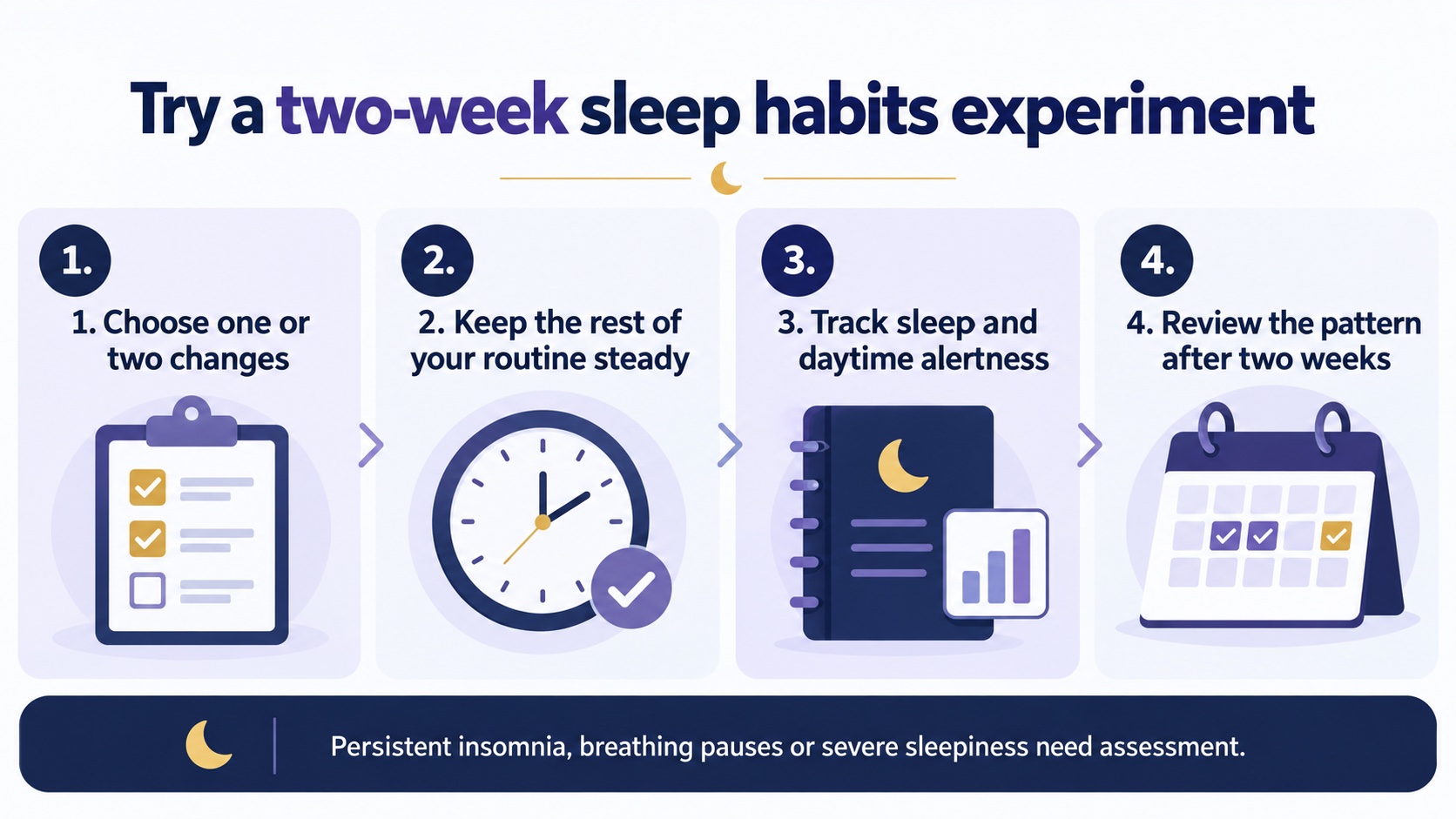
A two-week sleep-hygiene experiment
Do not use a self-directed experiment to delay care for unsafe sleepiness, concerning breathing, severe mental-health symptoms or another urgent problem.
- Record your current bedtime, wake time, estimated sleep, awakenings, naps, caffeine and daytime function for several typical days.
- Choose one to three habits that match the clearest pattern; do not try to perfect all 15 at once.
- Define the change precisely, such as “no caffeine after 1 p.m.” or “wake between 7:00 and 7:30 a.m.”
- Keep the rest of the routine reasonably stable for two weeks when practical.
- Compare patterns rather than judging one night, and note barriers that made the plan unrealistic.
- Keep useful changes, revise unhelpful ones and seek assessment when symptoms remain significant.
When sleep hygiene is not enough
Sleep hygiene alone is unlikely to resolve chronic insomnia disorder, sleep apnea, narcolepsy, restless legs syndrome, parasomnias or a circadian rhythm sleep-wake disorder. It also cannot remove work, caregiving, pain, housing or safety barriers that prevent adequate sleep.
For persistent insomnia, ask about assessment and CBT-I rather than assuming you need a stronger bedtime product. For loud snoring, breathing pauses, gasping, morning headaches or unexplained sleepiness, review the sleep apnea diagnosis process. If sleepiness affects driving or safety-sensitive work, stop the unsafe activity and arrange prompt professional advice.
Could this be sleep apnea?
Healthy habits help most people sleep better, but they will not fix sleep apnea. Consider getting checked if you have any of these:
- loud snoring, or someone has noticed you stop breathing or gasp in your sleep;
- you wake unrefreshed or with a headache, even after enough hours in bed;
- you doze off easily during the day, especially while driving.
Take the 2-minute sleep apnea quiz or order a home sleep test ($165, no referral needed).
Medical disclaimer
This content is educational and does not replace assessment, diagnosis or advice from a licensed healthcare provider. Do not change prescribed medicines or treatment based only on general sleep information.
Choose your next step
Complete guide: Sleep Health Guide: How to Sleep Better