

Quick answer
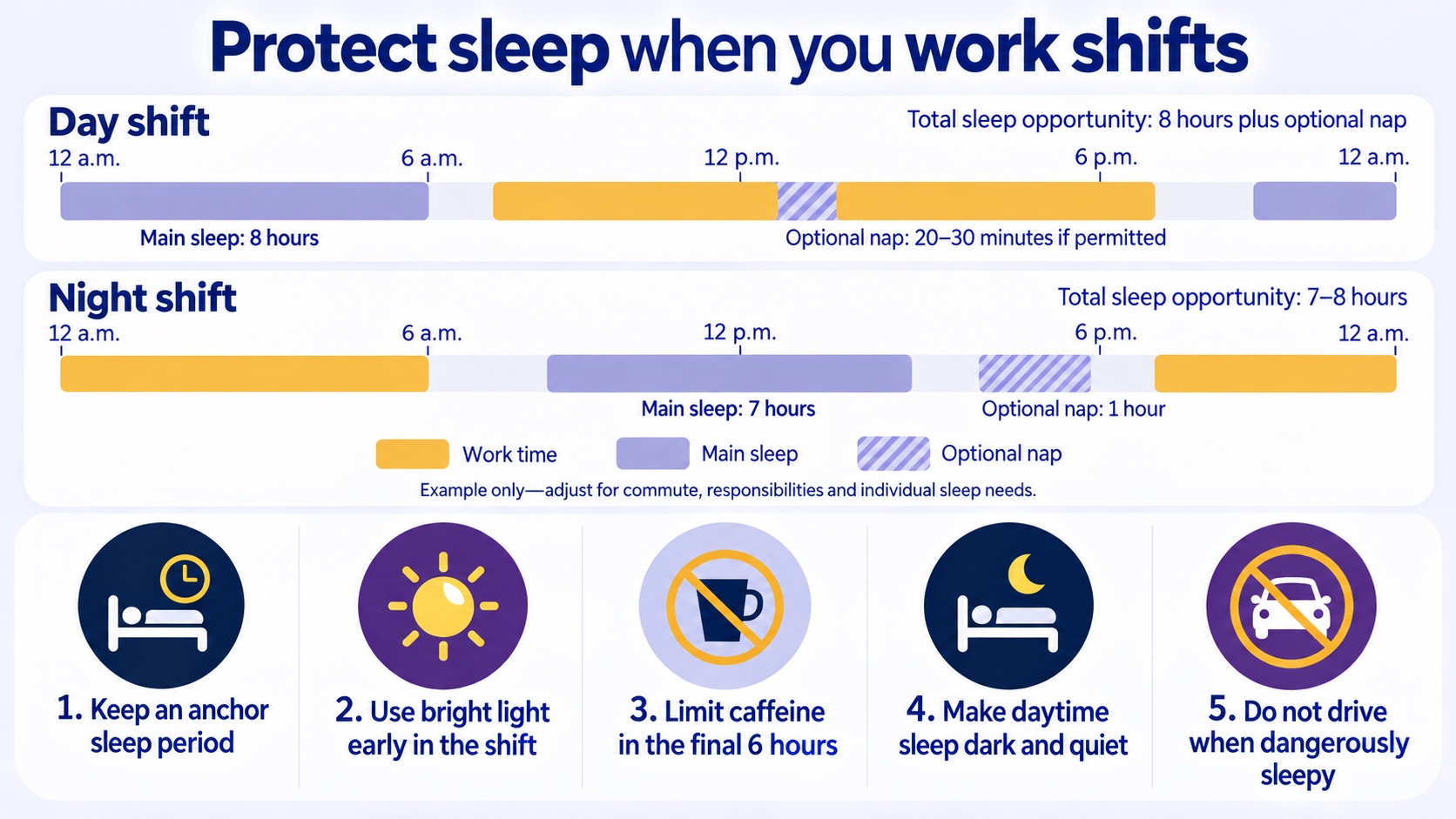
Shift work can place required wakefulness and sleep at odds with the body clock. A practical plan protects enough sleep opportunity, uses light and caffeine deliberately, makes naps safe, and anticipates the commute home. The best plan depends on whether shifts are permanent, rotating, early, overnight or unpredictable. Persistent insomnia, excessive sleepiness, near misses or difficulty functioning may need assessment for shift work disorder or another sleep or medical condition.
Why shift work can disrupt sleep
The circadian system promotes alertness and sleep at different biological times. Night work asks the brain and body to stay alert when sleep pressure is often strong, while daytime sleep competes with daylight, noise, household activity and the circadian drive for wakefulness. Early starts can also shorten sleep when a worker cannot fall asleep early enough.
Rotating and unpredictable schedules add another problem: the timing target changes before the body clock can settle. The American Academy of Sleep Medicine notes that full circadian adaptation is often not a realistic goal for people who rotate frequently. A useful plan may therefore focus on protecting sleep and managing alertness rather than trying to become completely nocturnal.
Not every shift worker develops shift work disorder. Tiredness after an occasional difficult shift is also not enough to diagnose it.
Start with the roster, not generic sleep advice
Write down at least one representative work cycle, including shift start and finish, travel, meals, caregiving, exercise, overtime and days off. Then identify when sleep is realistically possible. A plan that ignores the commute or family responsibilities will not be sustainable.
For each shift type, define:
Use Circadian Rhythm: Understanding Your Body Clock for the timing principles behind the plan.
- the main sleep period;
- whether a planned nap is needed;
- when bright light supports alertness and when light should be reduced;
- the latest useful caffeine time;
- when sleep inertia could affect driving or safety-sensitive work; and
- which commitments need to be moved or shared.
Protect enough sleep opportunity
Most adults need at least seven hours of sleep regularly, although individual need varies. Shift workers may need to combine a main sleep period with a planned nap when one continuous window is not possible. Protecting time in bed does not guarantee sleep, but repeatedly scheduling too little time makes adequate sleep impossible.
For daytime sleep, make the room dark, quiet and comfortably cool. Use blackout curtains or an eye mask, silence avoidable notifications and discuss the protected sleep window with household members. Earplugs or steady background sound may help when safe and appropriate. Plan food, medicines and fluids so they do not repeatedly interrupt sleep; discuss medication timing with a pharmacist or clinician rather than changing it yourself.
Use light strategically and safely
Bright light during the working period can support alertness and may shift circadian timing. Reducing bright morning light after a night shift may make it easier for some people to prepare for daytime sleep. The useful timing depends on the schedule, and poorly timed bright-light therapy can shift the body clock in an unwanted direction.
Do not use dark glasses or another light-reduction strategy when it makes driving, walking or situational awareness less safe. If light timing is being used as treatment for shift work disorder, obtain individualized guidance—especially with eye disease, migraine, bipolar disorder or medicines that increase light sensitivity.
Time caffeine around the planned sleep period
Caffeine can temporarily improve alertness, but it does not replace sleep and can make the next sleep period shorter or harder to start. Use the smallest useful amount early enough in the shift that its effects are less likely to overlap planned sleep. Count coffee, tea, cola, energy drinks, chocolate, pre-workout products and caffeine-containing medicines.
There is no universal cutoff because dose, sensitivity and metabolism vary. Track the final caffeine time and sleep onset for several comparable shifts. Health Canada recommends a maximum daily intake of 400 mg for adults, with lower limits for people who are pregnant, planning pregnancy or breastfeeding. Individual medical advice may call for a lower amount.
Read Caffeine and Sleep for a timing experiment and Canadian caffeine context.
Plan naps around purpose and sleep inertia
A planned nap before a night shift or during an authorized break can improve alertness for some workers. A shorter nap may reduce the chance of prolonged grogginess, while a longer nap may provide more sleep but can increase sleep inertia after waking. Response varies.
Allow time to become fully alert before driving, operating equipment, making critical decisions or returning to hazardous work. A nap should occur only where workplace rules and a safe environment permit it. It is a support strategy, not proof that a person is fit for duty.
See Napping: Benefits, Timing and When It Disrupts Sleep for a more detailed comparison.
A practical plan for common shift patterns
- Permanent nights: protect a consistent main sleep window after work or before the next shift, and reduce unnecessary swings on days off when practical. Full nocturnal adjustment is not always possible or desirable.
- Rotating shifts: plan separately for each shift block. Where workers have influence over scheduling, forward rotation and fewer rapid reversals may be easier for some people than repeated backward or unpredictable changes.
- Early starts: move the wind-down and sleep opportunity earlier in small steps and prepare transport, food and clothing before bed to protect the shortened morning.
- Split or on-call shifts: identify the longest dependable sleep opportunity and use planned recovery sleep without assuming sleep can be banked indefinitely.
- Several night shifts in a row: keep the daytime sleep environment and routine consistent across the block, then plan the transition rather than improvising after the final shift.
Food, alcohol, nicotine and movement
Large or heavy meals close to the planned sleep period can worsen discomfort, while going to bed very hungry can also disturb sleep. Prepare simple meals and snacks ahead of the shift and notice how timing affects alertness and sleep.
Alcohol may feel sedating but can fragment sleep and should not be used as a sleep aid. Nicotine is stimulating and can disturb sleep. Regular physical activity can support health and sleep, but a demanding workout should not repeatedly displace the main sleep window. Use the related guides on alcohol and sleep and exercise and sleep for more context.
Commute and workplace safety
Fatigue can impair attention, reaction time, judgment and communication. CCOHS treats fatigue as a workplace hazard and identifies shift patterns, workload, task timing, breaks and the work environment as contributing factors. Fatigue management should not be placed entirely on an individual worker.
Do not drive or perform safety-sensitive work when you are struggling to stay awake. Warning signs include repeated yawning, heavy eyelids, lane drift, missed exits, memory gaps, microsleeps and difficulty maintaining speed or focus. Caffeine, loud music, cold air or an open window do not make dangerous sleepiness safe. Stop in a safe place, notify the appropriate workplace contact and arrange a safer alternative.
Near misses, fatigue-related errors and unsafe schedules should be reported through the applicable workplace process. Employers can review staffing, rotation, overtime, break opportunities, high-risk task timing, commute risk and access to a safe rest area.
Shift work disorder and other causes of sleepiness
Shift work disorder involves persistent insomnia and/or excessive sleepiness associated with a recurring work schedule that overlaps usual sleep time. Assessment considers the schedule, symptom timing and duration, sleep opportunity, sleep diary and other possible causes. It is not diagnosed simply because someone works nights.
Sleep apnea, insomnia, restless legs syndrome, narcolepsy, depression, anxiety, pain, medicines, substance use and medical conditions can coexist with shift work. Loud snoring, witnessed breathing pauses, gasping, morning headaches or sleepiness despite adequate opportunity should not automatically be attributed to the roster. Review sleep apnea symptoms when those signs are present.
Treatments such as timed light, melatonin or prescription wake-promoting medication require individualized assessment. Timing errors, interactions, side effects and an untreated sleep disorder can change the balance of benefit and risk. Do not begin a supplement or borrow medication solely from general online advice.
Build a seven-day shift-work sleep record
For at least one representative work cycle, record:
Use the record to change one or two factors at a time. Bring it to a clinical assessment or workplace fatigue discussion when symptoms or safety concerns continue.
- shift and commute times;
- intended and estimated sleep periods;
- naps and time needed to feel alert afterward;
- caffeine amount and final intake time;
- major light exposure before work and before sleep;
- sleepiness during work and travel;
- snoring, breathing pauses or other symptoms reported by a partner; and
- errors, near misses or moments when staying awake felt difficult.
When to seek professional help
Seek assessment when insomnia or excessive sleepiness continues across a recurring shift schedule, you cannot obtain enough sleep despite protecting the opportunity, or symptoms affect health, mood, relationships or work. Prompt review is important after a microsleep, near miss, fatigue-related error or repeated difficulty staying awake while driving.
Also seek help when symptoms suggest another sleep disorder, including loud snoring, witnessed breathing pauses, gasping, irresistible sleep attacks or uncomfortable urges to move the legs. Call emergency services for immediate danger or urgent medical symptoms.
Could this be sleep apnea?
Healthy habits help most people sleep better, but they will not fix sleep apnea. Consider getting checked if you have any of these:
- loud snoring, or someone has noticed you stop breathing or gasp in your sleep;
- you wake unrefreshed or with a headache, even after enough hours in bed;
- you doze off easily during the day, especially while driving.
Take the 2-minute sleep apnea quiz or order a home sleep test ($165, no referral needed).
Medical disclaimer
This content is educational and does not replace workplace safety procedures, assessment, diagnosis or advice from a licensed healthcare provider. Do not drive or perform safety-sensitive work when you are struggling to stay awake.
Choose your next step
Complete guide: Sleep Health Guide: How to Sleep Better