
Sleep health education
Napping: Benefits, Timing & Sleep Inertia

Quick answer
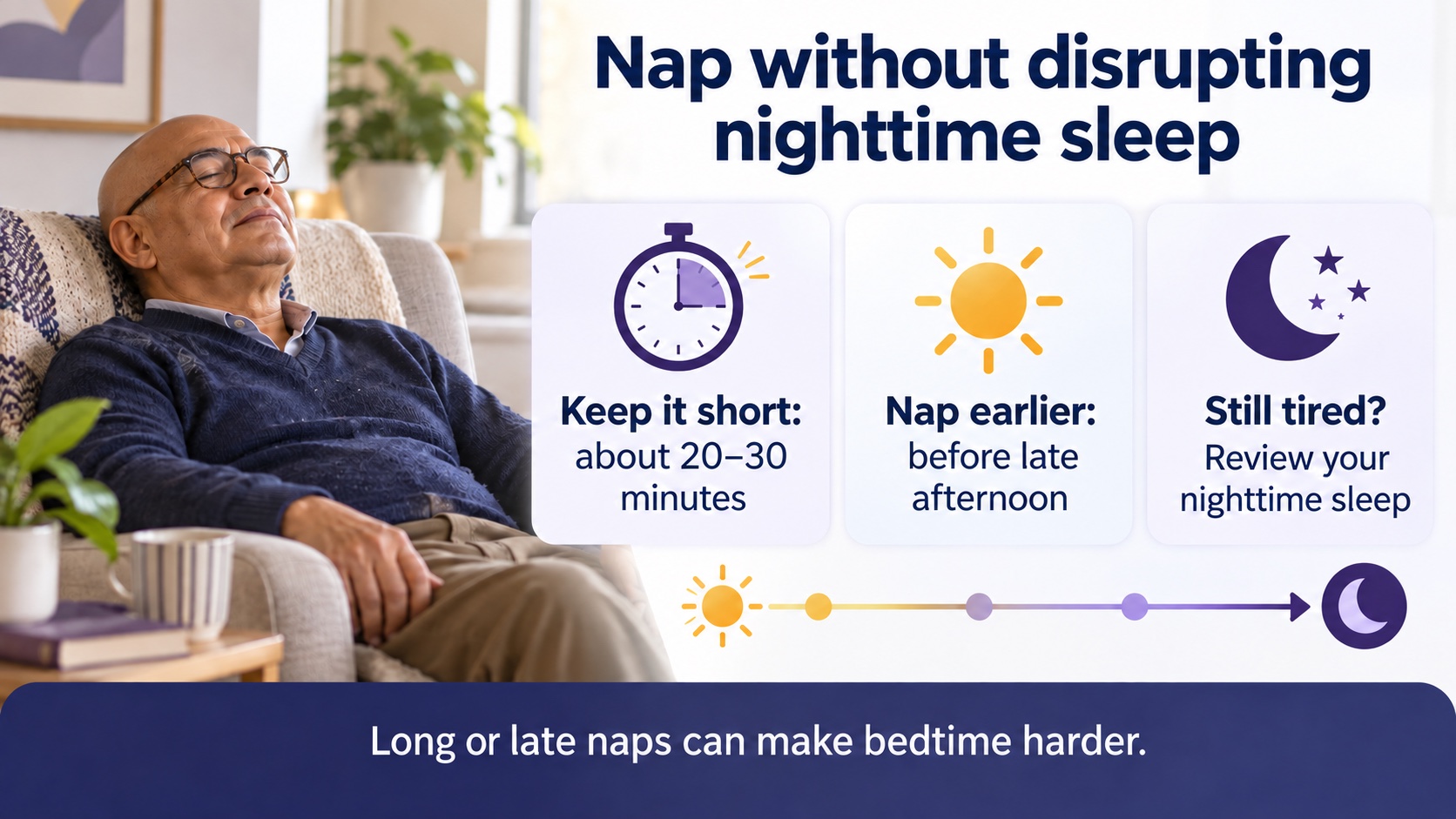
For most adults, a nap of 20 to 30 minutes taken in the early afternoon works best; napping after 3 p.m. can make it harder to sleep at night (Mayo Clinic). A nap can temporarily improve alertness, mood or performance, especially after restricted sleep or as part of a planned shift-work strategy. It can also make nighttime sleep harder when it is long, late or used to compensate for an unresolved sleep problem. The right length for you still depends on the goal, time of day, prior sleep, individual response and how soon alertness is required after waking.
Planned naps and unintended sleep are different
A planned nap has a chosen time, place and wake-up point. It may be used after an unusually short night, before some night shifts or when a healthcare professional recommends a structured schedule. Unintended dozing—during conversations, work, meals or driving—signals that sleepiness is exceeding a person’s ability to stay alert.
The distinction matters. A planned nap may support a broader sleep strategy; repeated unintended sleep can reflect insufficient sleep, medication effects, a circadian problem, sleep apnea, narcolepsy or another medical or mental-health condition. A nap can reduce the feeling of sleepiness without identifying its cause.
What a nap may help—and what it cannot fix
Research supports naps as a possible short-term countermeasure to fatigue and reduced performance. Some people also find a brief nap improves mood or concentration. Benefits depend on actually sleeping and may not appear immediately after waking.
Napping cannot reliably repay chronic sleep loss, make drowsy driving safe or treat insomnia, sleep apnea or another sleep disorder. If naps are needed because the main sleep period is consistently too short, protecting adequate sleep opportunity is the more important intervention. See How Much Sleep Do You Need? for a broader sleep-duration check.
Nap length is a trade-off, not a universal prescription
A brief nap is often chosen when the goal is alertness with less opportunity to enter deeper sleep. Guidance commonly uses about 20 minutes as a practical starting point for adults who are concerned about grogginess or nighttime sleep. This is not a guarantee: some people take most of that interval to fall asleep, while others can experience sleep inertia even after a short nap.
Longer naps create more opportunity for sleep but can also increase the chance of waking from deeper sleep, feeling disoriented or reducing sleep pressure for the coming night. They may have a role in a planned shift-work schedule, but should not be treated as automatically restorative or safe immediately before driving or critical work.
Timing matters because sleep pressure and the body clock interact
Sleep pressure generally builds while a person is awake and falls during sleep. A nap reduces some of that pressure. When a person already has difficulty falling asleep at night, a late-afternoon or evening nap may leave less pressure available at bedtime.
An early-afternoon nap often fits the natural dip in alertness and leaves more time before nighttime sleep. Shift workers follow a different schedule: the useful timing may be before or during a night shift and should be coordinated with the main sleep period, workplace policy, commute and time needed to recover after waking. Read Circadian Rhythm: Understanding Your Body Clock and Shift Work and Sleep for schedule-specific context.
Sleep inertia: plan for the period after waking
Sleep inertia is the temporary grogginess, slower thinking and reduced performance that can follow waking. It can last longer when a person is sleep deprived, wakes from deeper sleep or naps during the biological night. The exact duration is variable, so a timer alone does not guarantee immediate readiness.
Allow a buffer before driving, operating equipment, providing safety-sensitive care, making high-stakes decisions or returning to demanding work. If alertness does not return, do not proceed simply because the planned recovery time has passed.
Napping when you have insomnia
For someone with persistent difficulty falling asleep or staying asleep, frequent or late naps can weaken sleep pressure and perpetuate a cycle of poor nighttime sleep followed by daytime recovery sleep. A useful first step is to record naps alongside bedtime, estimated sleep onset, awakenings, wake time and daytime function.
That does not mean every person with insomnia must never nap. Advice should reflect safety, health conditions and the treatment plan. Cognitive behavioural therapy for insomnia may include individualized guidance about time in bed and napping; avoid applying a rigid internet rule in place of assessment.
Napping, snoring and sleep apnea symptoms
Needing naps does not diagnose sleep apnea. Concern increases when sleepiness occurs despite enough sleep opportunity or appears with loud habitual snoring, witnessed breathing pauses, gasping, morning headaches, dry mouth or concentration problems. Review the broader sleep apnea symptom pattern rather than using the success of a nap as evidence for or against a diagnosis.
If someone is falling asleep unintentionally, struggling to remain awake while driving or needing multiple naps to function, assessment should not wait for a perfect sleep diary. A nap may mask the severity of daytime sleepiness for a few hours without resolving its source.
A seven-day nap and sleep check
Use this only when it is safe to experiment and there is no urgent or uncontrollable sleepiness.
- Record the reason for each nap: planned recovery, habit, shift preparation or irresistible sleepiness.
- Note when you lay down, estimated time asleep and when you got up.
- Rate grogginess on waking and record how long it took to feel normally alert.
- Record bedtime, estimated sleep onset, awakenings and final wake time that night.
- Note caffeine, alcohol, medicines, illness, pain and unusual work or caregiving demands.
- Compare earlier and later naps, and shorter and longer naps, without changing several other habits at once.
- Bring the record to a healthcare professional if naps remain necessary, nighttime sleep worsens or daytime function is unsafe.
Driving and workplace safety
Do not use a planned nap as permission to continue driving while sleepy. If sleepiness occurs behind the wheel, stop in a safe location and follow applicable road-safety guidance; do not resume until adequately alert. Coffee, an open window, loud music and a short nap are not reliable substitutes for adequate sleep or assessment of recurring sleepiness.
Employers and workers should treat fatigue as a shared safety issue, especially with night work, long shifts and safety-sensitive tasks. A workplace nap policy should include a suitable location, coverage, wake-up plan and time for sleep inertia to clear.
When to seek help
Seek professional advice when naps are irresistible, unplanned, increasing, needed despite adequate nighttime sleep, or associated with loud snoring, breathing pauses, unusual behaviours, weakness triggered by emotion or medication changes. Prompt assessment is important when sleepiness affects driving, work, caregiving or other safety-sensitive activities.
Call emergency services for a crash, near-crash, sudden neurological symptoms, loss of consciousness or another urgent medical concern. This page is educational and does not replace individual assessment, diagnosis or treatment.
Could this be sleep apnea?
Healthy habits help most people sleep better, but they will not fix sleep apnea. Consider getting checked if you have any of these:
- loud snoring, or someone has noticed you stop breathing or gasp in your sleep;
- you wake unrefreshed or with a headache, even after enough hours in bed;
- you doze off easily during the day, especially while driving.
Take the 2-minute sleep apnea quiz or order a home sleep test ($165, no referral needed).
Choose your next step
Complete guide: Sleep Health Guide: How to Sleep Better