
Sleep health education
How Much Sleep Do You Need? A Guide by Age

Quick answer
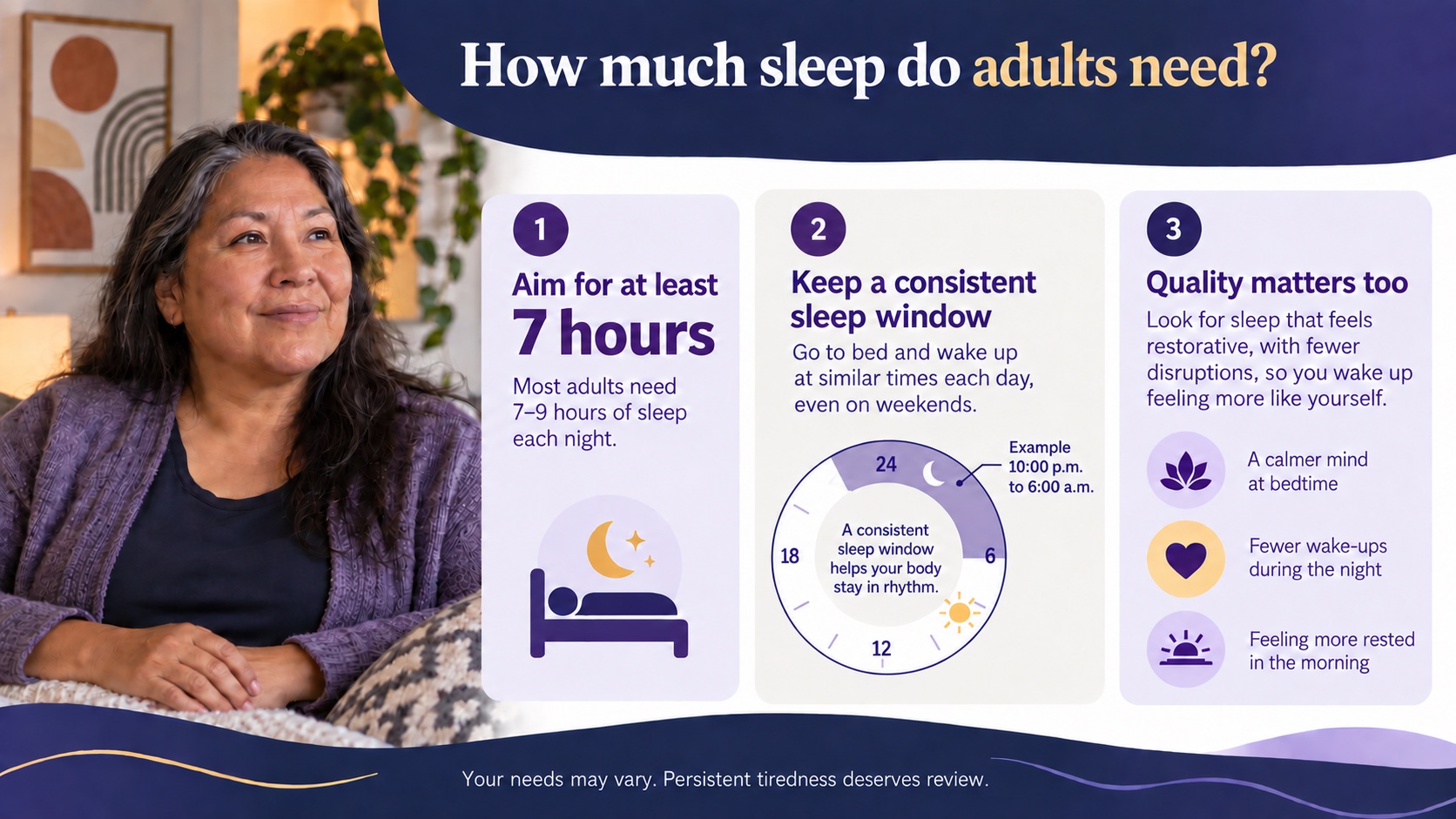
Canada’s 24-Hour Movement Guidelines recommend 7 to 9 hours of good-quality sleep a night for adults aged 18 to 64, and 7 to 8 hours for adults 65 and older, with consistent bed and wake-up times (Canadian Society for Exercise Physiology). Infants, children and teenagers need more. Age-based ranges are a useful starting point, not a diagnosis or a promise that the same number suits everyone. Enough sleep should also leave time for reasonable daytime alertness and function.
Sleep recommendations by age
These consensus ranges describe sleep in a 24-hour period. For babies and young children, the total includes naps. The American Academy of Sleep Medicine does not give one range for infants younger than four months because normal sleep varies widely at that age.
Recommendations are a starting range, not a personal diagnosis
People within the same age group can function best at different points in the recommended range. Illness, pregnancy, recovery from sleep loss, demanding schedules and some health conditions may temporarily change sleep need. A number alone cannot show whether sleep is restorative or whether a sleep disorder is present.
Sleep need, time in bed and sleep opportunity are different
Sleep need is the amount your body requires. Sleep opportunity is the time protected for sleep. Time in bed includes periods spent awake, so eight hours in bed does not always equal eight hours asleep. Build in enough opportunity for your target without extending time in bed indefinitely to chase sleep.
Quality, timing and regularity matter too
Repeated awakenings, pain, breathing disruption or a schedule that conflicts with the body clock can make a long night feel unrefreshing. A regular wake time and a repeatable bedtime routine can support timing, while the circadian rhythm guide explains how light and schedule help set the body clock.
Canada’s 24-Hour Movement Guidelines recommend 7 to 9 hours of good-quality sleep for adults 18–64, and 7 to 8 hours for adults 65+, “with consistent bed and wake-up times”.
- In a UK study of about 61,000 adults who wore activity trackers, the people with the most regular sleep patterns had about a 30% lower risk of death over the following years than those with the least regular patterns. Regularity predicted risk better than sleep duration did (Windred et al., SLEEP, 2024).
- This is an association, not proof of cause, but it supports keeping your wake-up time steady, including on weekends.
How to estimate your own sleep need
Use a two-week sleep record during a reasonably typical period rather than judging one night. Record:
Look for the amount and schedule associated with easier waking and steadier daytime function. A diary cannot diagnose a disorder, but it gives a clinician more useful context than one unusually good or bad night.
- when you got into bed and when you tried to sleep;
- your estimated time to fall asleep and time awake overnight;
- final wake time, naps and whether an alarm was needed;
- daytime sleepiness, concentration, mood and reliance on caffeine; and
- changes such as illness, alcohol, shift work, travel or caregiving.
Signs that sleep may be insufficient
Difficulty waking, unintended dozing, irritability, reduced concentration, frequent errors and needing repeated alarms or stimulants can occur when sleep opportunity is too short. Feeling tired is not specific to sleep loss, however; medicines, mood, medical conditions, circadian timing and sleep disorders can produce similar symptoms.
What sleep debt and weekend catch-up mean
Repeated short nights create cumulative sleep loss. Extra weekend sleep may reduce some immediate sleepiness, but large swings in sleep and wake times can make Monday mornings harder and do not address the schedule that created the deficit. Protecting adequate time across the week is more reliable than repeatedly borrowing sleep and trying to repay it later.
Can you catch up on sleep on weekends?
Sleeping in after a short week can help you feel more alert, but it does not fully cancel a regular pattern of too little sleep. A large gap between workday and weekend sleep times, often called social jet lag, can make Monday mornings harder.
Sleep debt, catch-up sleep and social jet lag are different
Sleep debt is a practical way to describe sleep repeatedly missed relative to what an individual needs. Catch-up sleep is extra sleep obtained later. Social jet lag describes the difference between sleep timing on work or school days and free days, often estimated using the midpoint of the main sleep period.
These ideas overlap but are not interchangeable. Someone can sleep longer on weekends with little timing change, shift timing substantially without adding much sleep, or do both. Social jet lag is also different from travel jet lag: no time zones are crossed, although the repeated schedule change can make an early required wake time feel difficult.
A practical weekend strategy
A “within one hour” target is a common practical starting point, not a universal medical rule. A rigid target may be unrealistic for shift workers, caregivers, parents, adolescents, people recovering from illness or anyone whose weekday schedule severely limits sleep.
- If weekday sleep opportunity is too short, protect an earlier bedtime or reduce an avoidable demand where feasible.
- If you are recovering from one unusually short night, allow additional sleep while returning gradually to the required schedule.
- If timing drifts because of social plans, preserve a morning anchor that still leaves adequate sleep.
- If your natural sleep period is consistently much later than obligations allow, review the circadian rhythm guide rather than assuming lack of discipline.
- If rotating or overnight work drives the difference, use the shift-work sleep guide; standard Monday-to-Friday advice may not fit.
Why you may feel tired after enough hours
If you regularly allow enough sleep but remain unrefreshed, consider sleep quality and timing rather than simply adding more hours. Loud snoring, witnessed breathing pauses, gasping, morning headaches or marked daytime sleepiness can be part of a broader sleep apnea symptom pattern. Persistent symptoms should be assessed because sleep apnea, insomnia, restless legs, circadian disorders and non-sleep conditions require different approaches.
Shift work, caregiving and irregular schedules
Not everyone can follow the same nightly schedule. When work or caregiving makes sleep irregular, protect the largest realistic sleep window, reduce interruptions and use light and caffeine deliberately. Avoid driving or safety-sensitive work when struggling to remain awake.
When to seek help
Seek professional advice when sleepiness persists despite adequate sleep opportunity, sleep problems interfere with daily life, or someone observes loud snoring, gasping or breathing pauses. Urgent assessment is appropriate for severe or rapidly worsening symptoms. Do not drive when struggling to stay awake.
Medical disclaimer
This content is educational and does not replace assessment, diagnosis or advice from a licensed healthcare provider.
Could this be sleep apnea?
Healthy habits help most people sleep better, but they will not fix sleep apnea. Consider getting checked if you have any of these:
- loud snoring, or someone has noticed you stop breathing or gasp in your sleep;
- you wake unrefreshed or with a headache, even after enough hours in bed;
- you doze off easily during the day, especially while driving.
Take the 2-minute sleep apnea quiz or order a home sleep test ($165, no referral needed).
Choose your next step
Complete guide: Sleep Health Guide: How to Sleep Better