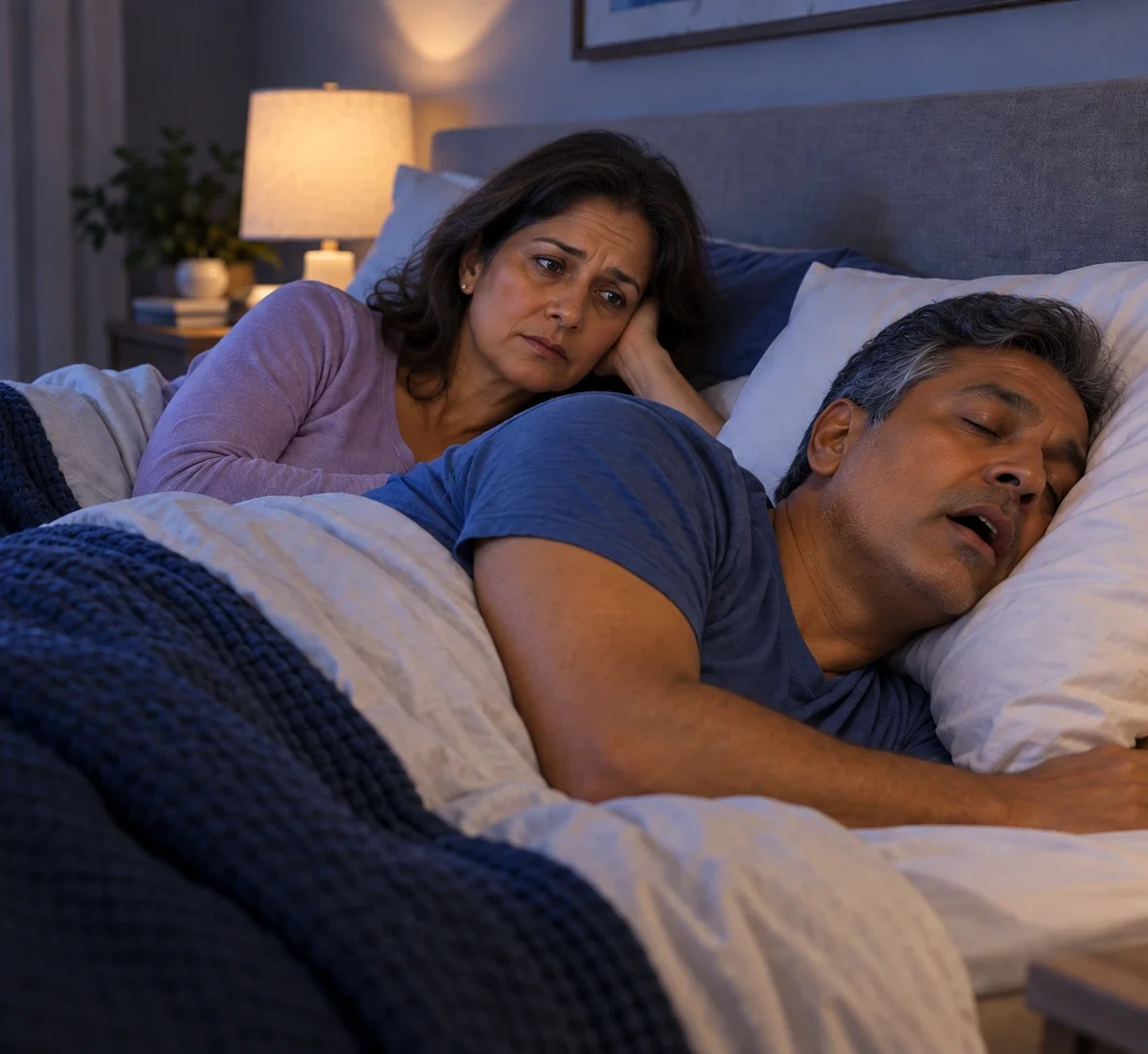
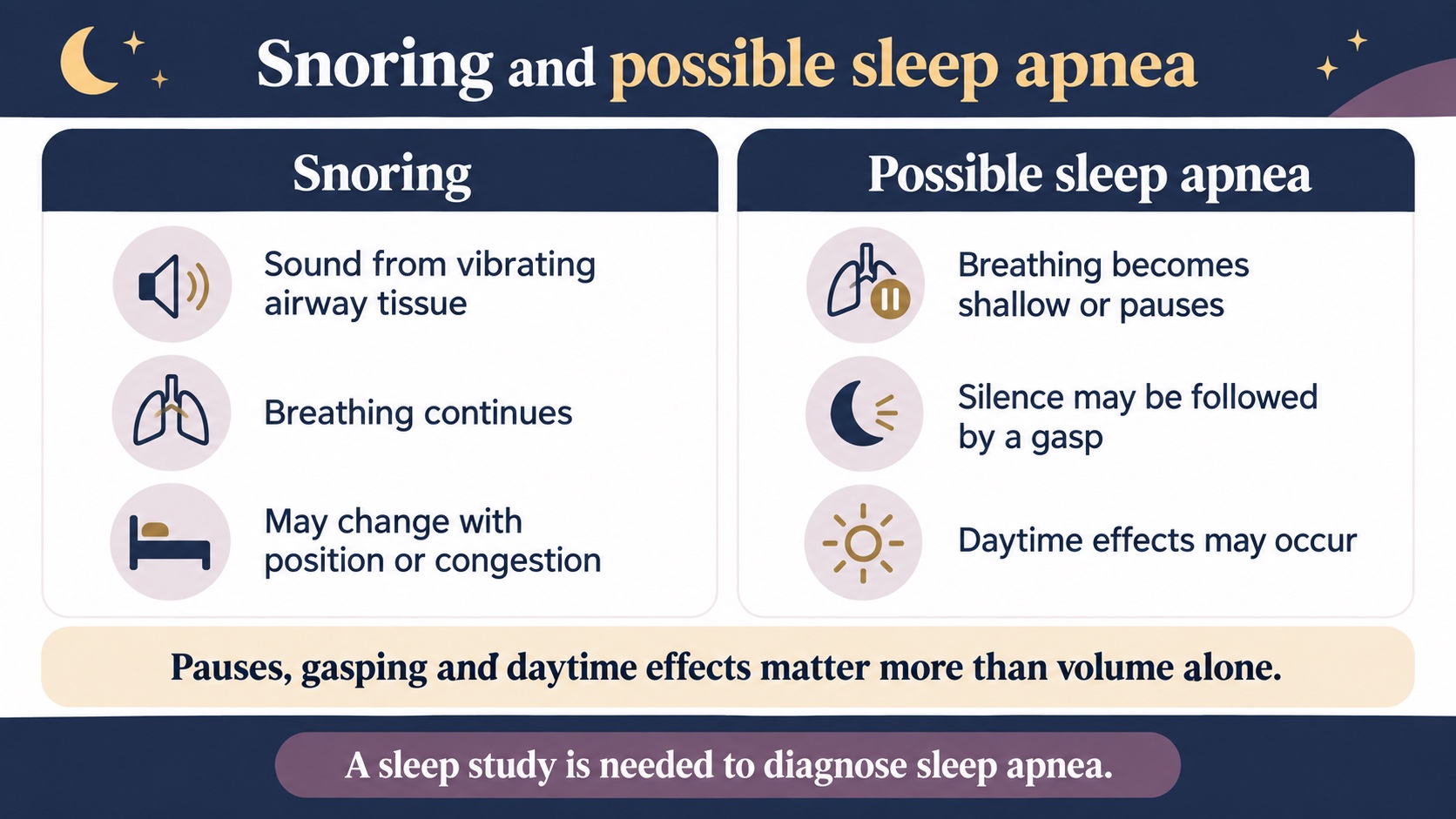
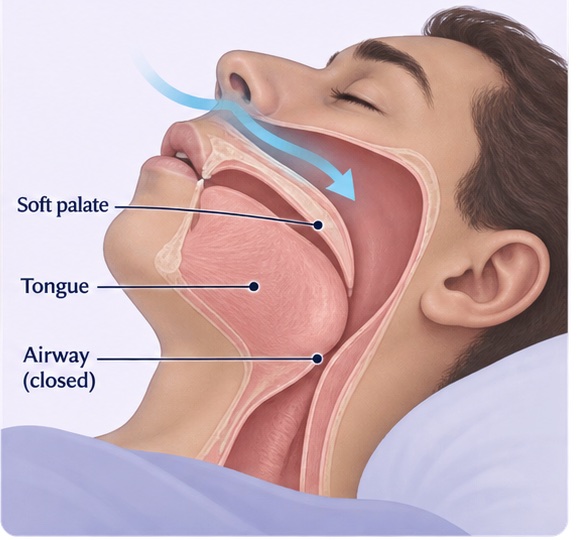
Snoring is a sound caused by vibration in a narrowed upper airway; it does not automatically mean sleep apnea. Sleep apnea involves repeated reductions or pauses in breathing during sleep. Concern is greater when snoring occurs with witnessed pauses, gasping, choking, morning headaches or significant daytime sleepiness.
Understanding your airway
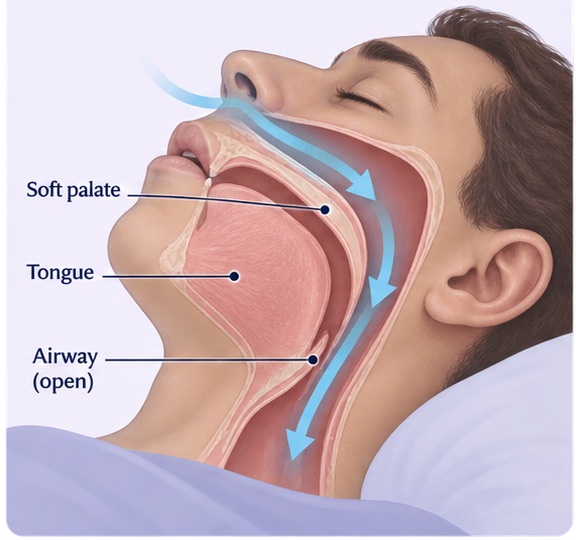
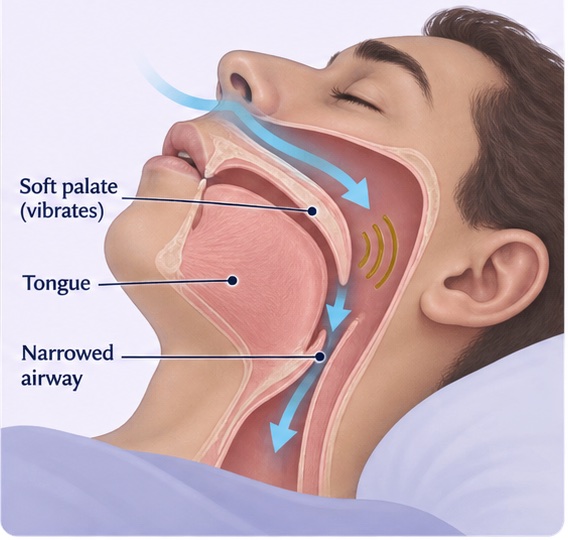
How airflow changes during sleep
Compare an open airway with the narrowing that can cause snoring and the closure that occurs during obstructive sleep apnea.
Normal breathing
Snoring
Obstructive sleep apnea
AirflowTissue vibration×Airflow stops
This simplified illustration is for education and does not diagnose sleep apnea.
At a glance
Key Takeaways
Takeaway 1
Snoring is a sound; sleep apnea involves repeated reductions or pauses in breathing during sleep.
Takeaway 2
Pauses, gasping and daytime effects matter more than snoring volume alone.
Takeaway 3
A sleep study—not a recording or observation—is needed to diagnose sleep apnea.
What Snoring Is
Snoring occurs when air moving through a narrowed upper airway makes nearby tissues vibrate. It can be occasional or persistent and may be influenced by sleep position, nasal congestion, alcohol and anatomy.
What Makes Sleep Apnea Different
Sleep apnea involves repeated breathing reductions or pauses, not simply sound. A partner may hear loud snoring followed by silence and then a gasp or snort as breathing resumes.
Breathing continues, although the upper airway vibrates and creates sound.
Breathing repeatedly becomes shallow or stops during sleep.
Sound pattern
May be steady or change with sleep position, congestion, alcohol or illness.
May include loud snoring followed by quiet pauses, gasping, choking or snorting.
Nighttime observations
Sound may disturb a partner, but pauses are not observed.
A partner may notice pauses, restless sleep or repeated gasping.
Daytime effects
Snoring alone may occur without marked daytime symptoms.
Unrefreshing sleep, sleepiness, morning headaches or concentration problems may occur.
When to seek assessment
Discuss persistent or disruptive snoring if it concerns you.
Seek assessment when breathing changes, persistent symptoms or alertness and safety concerns occur.
How it is confirmed
Snoring itself does not establish or exclude sleep apnea.
Diagnosis requires an appropriate sleep study interpreted in clinical context.
Questions For A Bed Partner
Ask whether snoring is nightly, whether breathing appears to stop, whether there is choking or gasping, and whether sleep seems restless. Note that loudness can vary with sleep position, congestion, alcohol or illness. Short recordings can provide useful context for a clinician but do not diagnose the condition or show its severity.
When Snoring Deserves Assessment
Assessment is appropriate when snoring is loud and persistent, another person reports pauses, or the sleeper has unrefreshing sleep, daytime sleepiness or concentration problems. Do not drive when too sleepy to do so safely.
What Happens During Testing
A provider decides whether a home sleep apnea test or in-laboratory study is suitable. Testing measures breathing-related signals that household observations cannot and must be interpreted alongside symptoms and health history. Learn more about how sleep apnea is diagnosed and the differences between a home sleep test and a sleep lab.
Common questions
Frequently Asked Questions
Does loud snoring always mean sleep apnea?
No. Loud snoring can occur without sleep apnea. It is more concerning when it occurs with observed pauses, gasping, unrefreshing sleep, or significant daytime sleepiness.
Does snoring alone mean I need a sleep study?
Not always. A clinician considers the full symptom pattern, health history, and observations from a bed partner to decide whether testing is appropriate.
Do anti-snoring devices treat sleep apnea?
Not reliably. Over-the-counter mouthpieces, nasal strips and sprays can make snoring quieter without treating the breathing pauses underneath. Get assessed for sleep apnea before relying on them, especially if a partner has noticed pauses or gasping.
Can sleeping on my side reduce snoring?
Often, yes. Snoring and obstructive events are usually worse on your back. Side sleeping can help, but if you also have pauses, gasping or daytime sleepiness, it is still worth getting tested.
Observed pauses, gasping and daytime effects are useful reasons to discuss assessment. Learn how sleep apnea is diagnosed or review the broader symptom pattern.
To provide the best experiences, we use technologies like cookies to store and/or access device information. Consenting to these technologies will allow us to process data such as browsing behavior or unique IDs on this site. Not consenting or withdrawing consent, may adversely affect certain features and functions.
Functional
Always active
The technical storage or access is strictly necessary for the legitimate purpose of enabling the use of a specific service explicitly requested by the subscriber or user, or for the sole purpose of carrying out the transmission of a communication over an electronic communications network.
Preferences
The technical storage or access is necessary for the legitimate purpose of storing preferences that are not requested by the subscriber or user.
Statistics
The technical storage or access that is used exclusively for statistical purposes.The technical storage or access that is used exclusively for anonymous statistical purposes. Without a subpoena, voluntary compliance on the part of your Internet Service Provider, or additional records from a third party, information stored or retrieved for this purpose alone cannot usually be used to identify you.
Marketing
The technical storage or access is required to create user profiles to send advertising, or to track the user on a website or across several websites for similar marketing purposes.