
Sleep health education
Caffeine and Sleep: Timing, Sensitivity and Better Choices

Quick answer
Health Canada recommends no more than 400 mg of caffeine a day for healthy adults and 300 mg for people who are pregnant or breastfeeding. A 237 mL cup of brewed coffee has about 135 mg, black or green tea about 30 to 50 mg, and a 355 mL can of cola about 36 to 46 mg (Health Canada). Staying under the daily limit does not guarantee good sleep: caffeine late in the day can still delay sleep or make it lighter, so many people sleep better when they stop caffeine by early afternoon.
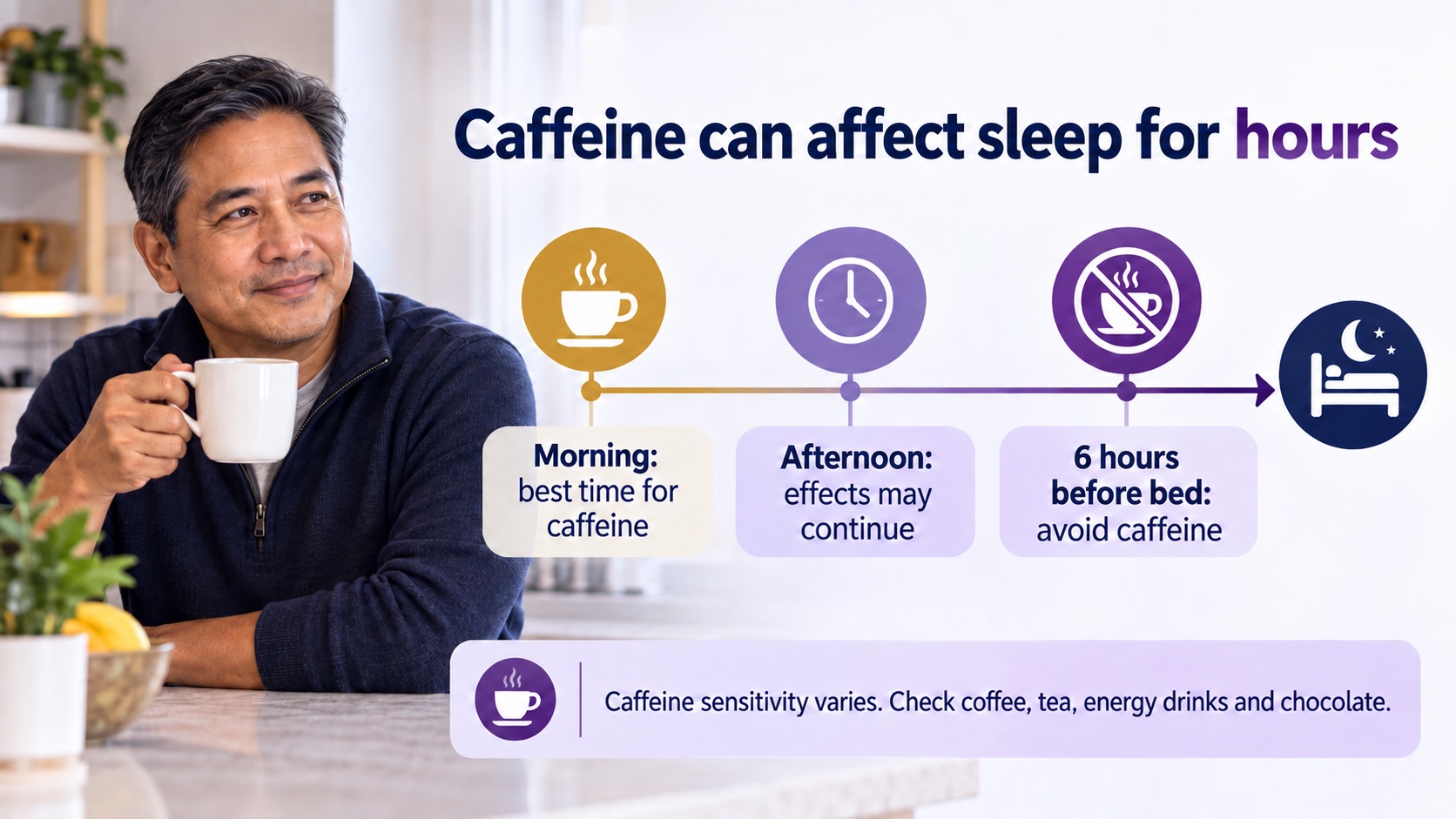
How caffeine affects sleep pressure
Adenosine builds in the brain during time awake and contributes to the pressure to sleep. Caffeine temporarily blocks adenosine receptors, which can reduce the perception of sleepiness and improve alertness. It does not replace sleep or erase accumulated sleep loss.
Depending on dose, timing and sensitivity, caffeine can make it take longer to fall asleep, shorten total sleep time, increase lighter sleep and reduce deeper sleep. You may still fall asleep at your usual time and notice the effect mainly as lighter sleep, earlier waking or feeling less restored the next day.
How long can caffeine affect sleep?
Caffeine is absorbed relatively quickly but cleared much more slowly. A meaningful portion can remain in the body many hours after a drink, and clearance differs from person to person. Pregnancy, some medications, liver health, smoking status and individual biology can change how long the effects last.
A 2023 systematic review and meta-analysis found that caffeine reduced total sleep time by an average of about 45 minutes across the included studies. Its dose-and-timing model estimated that a coffee containing 107 mg of caffeine would need to be consumed about nine hours before bedtime to avoid a reduction in total sleep time, while a higher-dose pre-workout serving required a substantially longer interval. Those estimates illustrate that dose matters; they are not a universal cutoff or a promise about an individual night.
An earlier controlled study also found that 400 mg of caffeine disrupted sleep when taken six hours before bedtime. A practical starting point for someone with sleep difficulty is therefore to move the last caffeine at least six to eight hours before bed, then adjust earlier if sleep remains affected.
Daily maximums are not bedtime recommendations
Health Canada recommends no more than 400 mg of caffeine per day for adults aged 18 and older. The recommended maximum is 300 mg per day for people who are pregnant, breastfeeding or planning pregnancy. Individual medical advice may call for less.
These are daily intake recommendations designed around general health and safety. They do not mean that a person can consume the full amount late in the day without affecting sleep. Someone who is caffeine-sensitive may sleep better at a much lower total, with an earlier stopping time, or without caffeine.
How much caffeine is in common products?
Serving size, brewing method and brand can change the amount substantially. Health Canada’s averages provide useful context:
A café cup may be much larger than 237 mL, and energy drinks, energy shots or pre-workout supplements may deliver a concentrated dose. Health Canada permits up to 180 mg of caffeine per serving in a caffeinated energy drink and requires cautionary labelling. Check the full container and serving information rather than assuming one can equals one moderate dose.
Why sensitivity differs so much
Two people can consume the same drink at the same time and have different sleep effects. Differences can reflect habitual intake, age, genetics, pregnancy, health conditions, medicines, the size of the dose and the amount of sleep debt already present.
Tolerance can reduce how strongly you notice alertness or jitteriness, but it does not prove sleep is unaffected. Likewise, being able to fall asleep after coffee does not show that sleep duration, depth or continuity stayed the same. Your repeated sleep pattern is more informative than how stimulated you feel in the moment.
Try a one- to two-week timing experiment
Make one clear change long enough to compare several nights:
If the change helps, choose a cutoff and total that you can maintain. If it does not, caffeine may not be the only issue. Place the experiment inside a consistent bedtime routine and review evidence-informed sleep habits rather than changing many variables at once.
- Record every caffeine source, serving size and approximate milligrams for three typical days.
- Keep the morning amount stable so the experiment is easier to interpret.
- Move the final caffeine at least six to eight hours before the intended bedtime. Move it earlier if you are sensitive, use a higher dose or still have difficulty sleeping.
- Track bedtime, estimated time to fall asleep, awakenings, total sleep time and next-day alertness.
- Compare workdays and days off, and note alcohol, naps or schedule changes that could confuse the pattern.
Reduce gradually if withdrawal is a problem
Regular caffeine use can lead to physical dependence. Stopping suddenly may cause headache, fatigue, irritability, difficulty concentrating or flu-like feelings. These symptoms can make it tempting to restart a late-day dose and can obscure whether sleep is improving.
A gradual reduction is often easier—for example, decreasing serving size, mixing regular and decaf, or replacing one serving at a time. Seek professional advice if caffeine use is very high, symptoms are severe, or another health condition or medicine affects the plan.
Caffeine, shift work and safety
Caffeine may temporarily support alertness during night or shift work, but poorly timed use can make the following sleep period shorter or harder to start. Use it strategically early enough in the shift to reduce interference with planned sleep, and do not treat it as permission to extend wakefulness indefinitely. See practical sleep strategies for shift work.
Caffeine does not make drowsy driving safe. If you are struggling to keep your eyes open, drifting across lanes or missing parts of the drive, stop driving and address the immediate safety risk. A caffeinated drink is not a substitute for adequate sleep.
When caffeine is masking another sleep problem
Needing progressively more caffeine to function can be a clue that sleep opportunity, sleep quality or health needs attention. Look beyond caffeine when tiredness persists despite enough time in bed, or when there is loud snoring, gasping, witnessed breathing pauses, morning headaches or uncontrollable daytime sleepiness.
Caffeine does not treat insomnia, sleep apnea or another sleep disorder. Review why persistent tiredness deserves a broader look and common sleep apnea symptoms. Seek professional advice when symptoms persist or affect mood, work, school or safety.
Could this be sleep apnea?
Healthy habits help most people sleep better, but they will not fix sleep apnea. Consider getting checked if you have any of these:
- loud snoring, or someone has noticed you stop breathing or gasp in your sleep;
- you wake unrefreshed or with a headache, even after enough hours in bed;
- you doze off easily during the day, especially while driving.
Take the 2-minute sleep apnea quiz or order a home sleep test ($165, no referral needed).
Medical disclaimer
This content is educational and does not replace assessment, diagnosis, emergency care or advice from a licensed healthcare provider.
Choose your next step
Complete guide: Sleep Health Guide: How to Sleep Better