
Sleep health education
Circadian Rhythm: Understanding Your Body Clock
Quick answer: Your circadian rhythm is an internal timing system that helps coordinate sleep and wakefulness across roughly 24 hours. Light and darkness help set that timing. A consistent sleep schedule and appropriate light exposure can support it. Persistent difficulty sleeping at the times you need warrants a healthcare discussion.

Work with your body clock
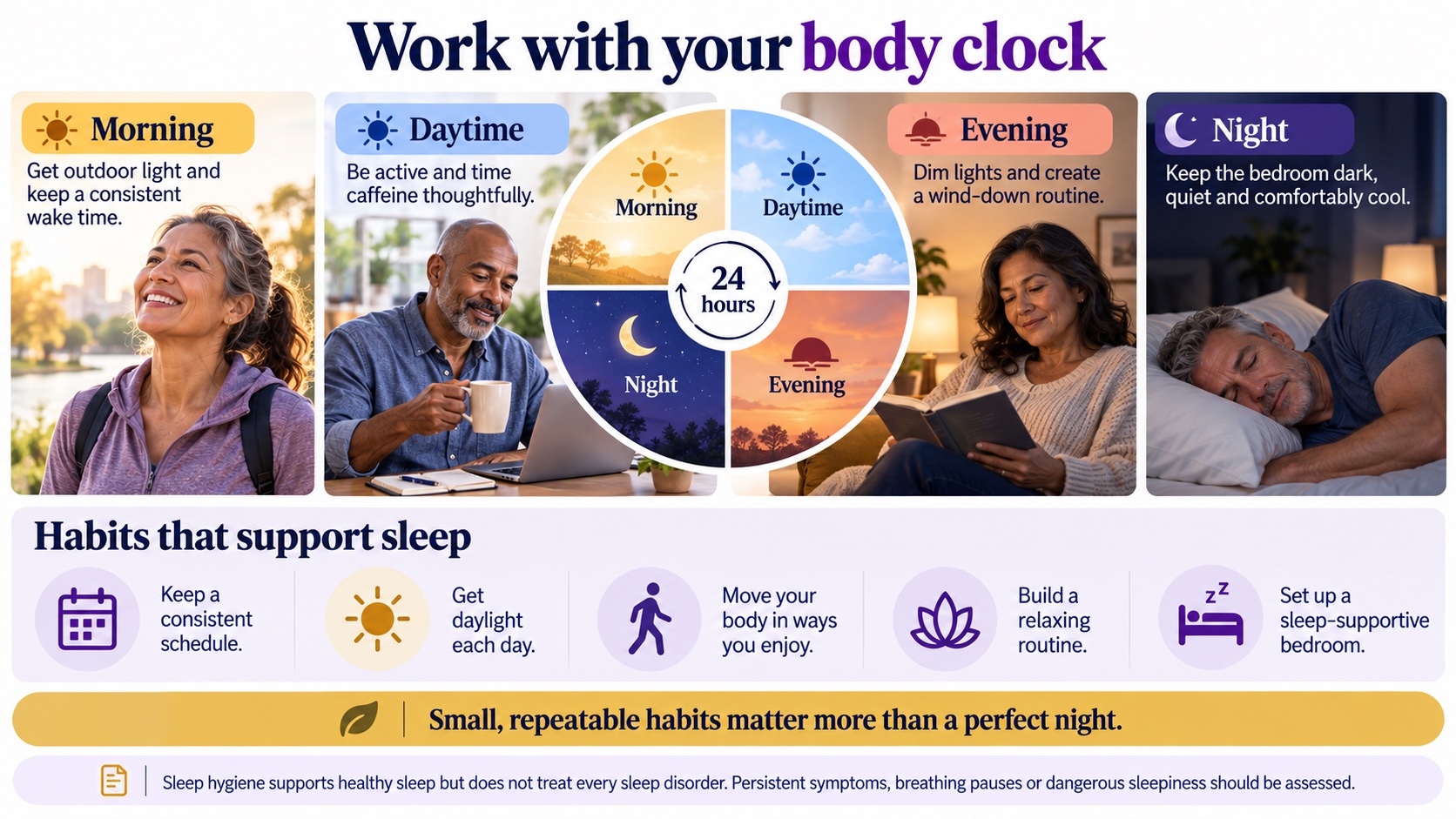
- Seek morning light and keep a regular wake time.
- Be active during the day and notice stimulant timing.
- Dim light and follow a calm wind-down routine in the evening.
- Keep the bedroom dark, quiet and comfortable at night.
What is a circadian rhythm?
“Circadian” means approximately a day. Nearly every tissue and organ has biological rhythms, coordinated by a master clock in the brain called the suprachiasmatic nucleus. This clock uses light information received through the eyes to help align internal time with the external day.
As evening darkness arrives, the circadian system normally supports melatonin production and preparation for sleep. Toward morning, other signals promote waking and alertness. Circadian rhythms influence more than sleep, which is why being awake and eating at biological night can feel different from doing the same activities during the day.
Body clock and sleep pressure are different
Two interacting processes help determine sleep and wakefulness. Sleep pressure builds with time awake, partly through the accumulation of adenosine, and decreases during sleep. The circadian system creates a daily rhythm in the drive for alertness and sleep.
This explains two common experiences. You can feel a “second wind” late in the evening even after a long day because circadian alerting is still active. You can also feel profoundly sleepy during a night shift even after daytime sleep because the circadian system is promoting biological night. Caffeine can mask some sleep pressure temporarily, but it does not reset the clock or replace sleep.
Chronotype is not automatically a disorder
Chronotype describes a person’s natural tendency toward earlier or later sleep and activity. Age, biology and environment all influence it. Teenagers and young adults often trend later, while many older adults trend earlier.
Being an “owl” or “lark” is not by itself a diagnosis. A circadian rhythm sleep-wake disorder is considered when the timing pattern is persistent, causes meaningful difficulty sleeping or waking at required times, and interferes with school, work, relationships, health or safety. The problem may be the mismatch between biological timing and obligations rather than an inability to sleep under every condition.
Light is the strongest timing signal
Light reaching the eyes can shift circadian timing and suppress melatonin. The direction of the shift depends on biological timing: light after waking commonly helps move a delayed schedule earlier, while bright evening and nighttime light often pushes timing later. For someone with an unusually early body clock, the appropriate timing can be different.
Intensity, duration, wavelength and prior light exposure also matter. Outdoor daylight is usually much brighter than ordinary indoor lighting, even on an overcast day. Evening screen light contributes, but room lighting and the time spent on stimulating content are part of the same environment. See what screens really do to sleep for that fuller explanation.
Do not use a very bright light box at an arbitrary time to “force” a reset. Poorly timed light can shift the clock in the wrong direction. People with eye disease, bipolar disorder or medicines that increase light sensitivity should seek clinical guidance before therapeutic bright-light use.
What can disrupt circadian timing?
Common causes of circadian misalignment include:
Daylight saving time changes can cause a short-lived mismatch too. Most people adjust, but a person who already has a late, early or irregular pattern may notice a larger effect. Explore weekend sleep and social jet lag or sleep strategies for shift work when those are the main pressures.
- rotating or overnight work;
- travel across multiple time zones;
- large differences between weekday and weekend schedules;
- late-night light and activity combined with early obligations;
- inconsistent wake times, naps or meals;
- reduced daytime light exposure;
- illness, some neurological conditions, medications or substance use.
Common sleep problems compared
These problems can overlap. For example, a shift worker can have circadian misalignment and sleep apnea, or a person with delayed timing can also develop conditioned insomnia. Avoid assuming that every late bedtime is a circadian disorder or that changing the schedule will treat every cause of tiredness.
A seven-day body-clock check
Before trying to shift your schedule, record one typical week:
The pattern matters more than one poor night. A diary can show whether sleep shifts later on free days, whether an early alarm is repeatedly cutting sleep short, or whether symptoms remain even when you sleep on your preferred schedule. It cannot diagnose a circadian disorder on its own, but it gives a clinician better information.
- Bedtime, estimated sleep onset, awakenings and final wake time.
- Alarm use and how difficult it was to wake.
- The time you felt naturally sleepy and the time alertness was strongest.
- Morning and evening light exposure, including outdoor time and screens.
- Caffeine, alcohol, naps, exercise and meal timing.
- Work, school, caregiving and weekend schedule changes.
- Daytime sleepiness, concentration and any driving or workplace safety concerns.
Practical ways to strengthen a regular schedule
Start with the parts of the day that provide consistent timing cues:
See how to build a bedtime routine, how caffeine timing affects sleep and why alcohol can disrupt rest for focused help with those cues.
- Choose a wake time you can maintain most days, including days off, while still allowing enough sleep.
- Get outdoor light after waking when the goal is to move a delayed schedule earlier.
- Move bedtime gradually instead of going to bed hours early when you are not sleepy.
- Dim evening lighting and reduce bright, activating screen use before the intended bedtime.
- Keep meals and physical activity reasonably regular and avoid making large schedule changes all at once.
- Plan caffeine so it does not interfere with the intended sleep period and avoid alcohol as a sleep aid.
- Build a repeatable wind-down that connects the desired schedule with sleepiness.
What about melatonin?
Melatonin is both a hormone produced in response to darkness and an ingredient in regulated health products. A supplement’s effect on circadian timing depends heavily on when it is taken; taking it at the wrong time may be ineffective or shift timing in an unintended direction. More is not automatically better.
In Canada, licensed non-prescription melatonin products for sleep-related use are authorized for adults. Since June 2026, melatonin sold for sleep-related use in people under 18 is treated as a prescription drug. Adults should still check the product’s Natural Product Number, follow its label and discuss timing, dose, medicines, pregnancy or health conditions with a pharmacist or qualified healthcare provider. Do not drive or use machinery if a product causes drowsiness.
Shift work and jet lag need a different plan
Advice to seek morning light and avoid all nighttime light assumes a daytime schedule. Night workers may need planned light during work, light reduction on the trip home, strategic naps and a protected daytime sleep environment. Frequent rotation can make full adjustment unrealistic. Use the shift-work sleep guide rather than applying a standard morning routine unchanged.
Jet lag depends on travel direction, number of time zones, arrival schedule and trip length. Timed light, gradual schedule shifts and sometimes melatonin can help, but the correct direction and timing matter. A short trip may call for a different strategy from a long stay.
When to seek assessment
Consider professional assessment when you repeatedly cannot sleep or wake at the required times, sleep normally only on a substantially different schedule, or have severe sleepiness during work, school or driving. A clinician may use a detailed history, sleep diary and sometimes actigraphy to distinguish delayed sleep-wake phase, advanced sleep-wake phase, irregular sleep-wake rhythm, non-24-hour rhythm, shift-work disorder and other causes.
Seek a broader sleep assessment if there is loud snoring, gasping, witnessed breathing pauses, restless legs or persistent exhaustion despite adequate sleep opportunity. Review sleep apnea symptoms or why you may always feel tired.
Do not drive or perform safety-sensitive work when struggling to stay awake. Severe or sudden sleepiness, confusion or other acute symptoms require timely medical attention.
Could this be sleep apnea?
Healthy habits help most people sleep better, but they will not fix sleep apnea. Consider getting checked if you have any of these:
- loud snoring, or someone has noticed you stop breathing or gasp in your sleep;
- you wake unrefreshed or with a headache, even after enough hours in bed;
- you doze off easily during the day, especially while driving.
Take the 2-minute sleep apnea quiz or order a home sleep test ($165, no referral needed).
Medical disclaimer
This content is educational and does not replace assessment, diagnosis, emergency care or advice from a licensed healthcare provider.
Choose your next step
Complete guide: Sleep Health Guide: How to Sleep Better