
Quick answer
CPAP stands for continuous positive airway pressure. A CPAP machine draws in room air, filters it and delivers it through tubing and a mask at a prescribed pressure. The pressure supports the upper airway from inside so it is less likely to narrow or collapse during sleep. Most people continue breathing on their own; CPAP is not the same as a ventilator or supplemental oxygen, and it manages obstructive sleep apnea only while it is used.
Machine components
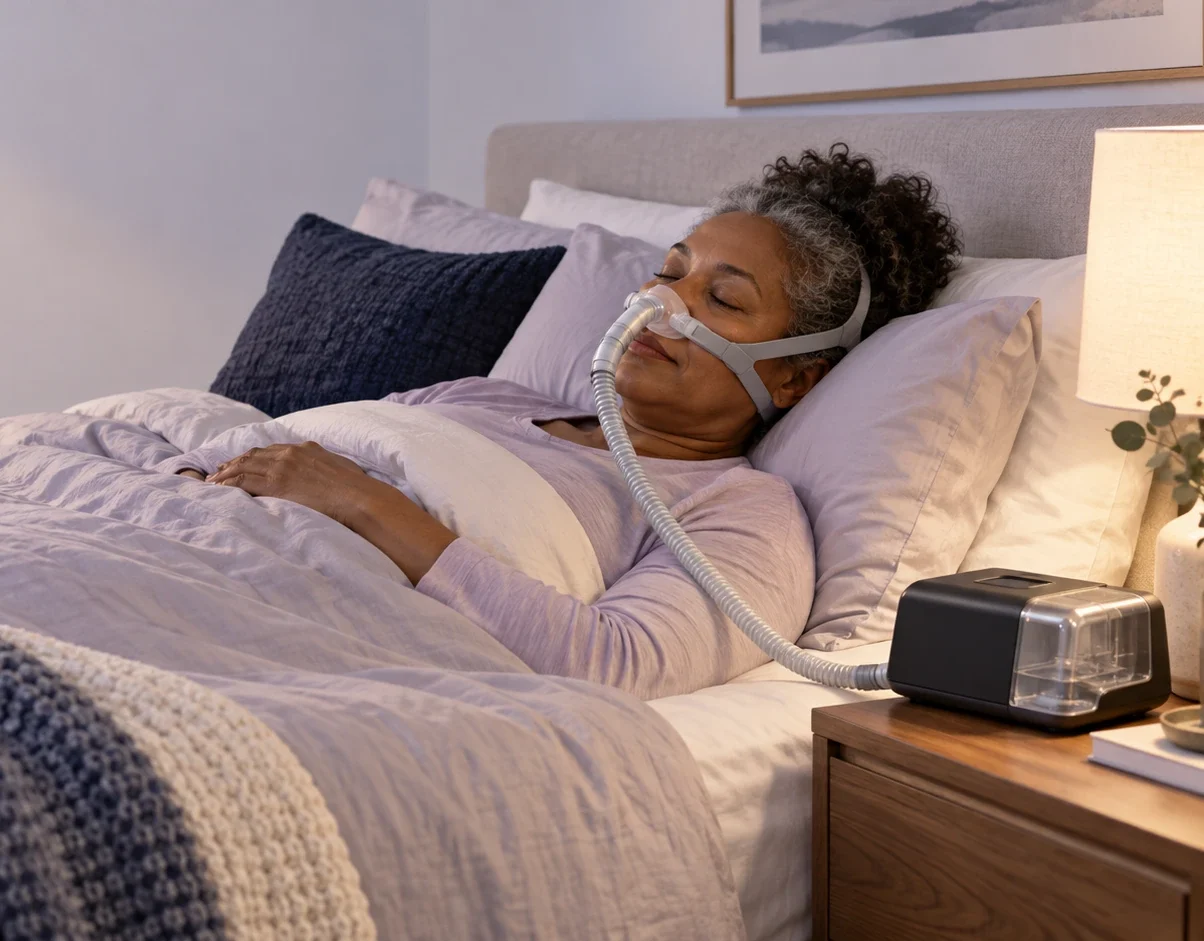
A typical CPAP system includes a flow generator, air filter, tubing, mask and headgear. Many bedside devices also include a heated humidifier, and some use heated tubing or data connectivity.
Each part has a distinct role:
Components are not universally interchangeable. Use the instructions and compatibility information for the exact machine, tubing, humidifier and mask rather than assuming that a similar-looking part will fit or function correctly.
- The flow generator draws in room air and creates the prescribed pressure.
- The filter helps keep airborne particles out of the device and airflow path.
- The tubing carries pressurized air from the machine to the mask.
- The mask and headgear form a stable connection to the nose, nostrils, or nose and mouth, depending on mask style.
- The intentional vent in the mask or connector allows exhaled carbon dioxide to leave the system. Never cover it.
- The humidifier adds moisture for comfort; it is not medicine and does not create oxygen.
- Connectivity or removable data storage may record usage and therapy-related information for follow-up.
How the airway collapses in obstructive sleep apnea
During sleep, the muscles that help keep the throat open relax. In obstructive sleep apnea, the upper airway repeatedly narrows or closes even though the chest and abdomen may continue trying to breathe. Airflow can decrease during a hypopnea or stop during an apnea, often followed by a brief arousal that restores the airway. A person may not remember these interruptions.
CPAP does not remove the tissue or anatomical factors that contribute to obstruction. Instead, it provides enough pressure to make collapse less likely while the treatment is in use.
The air-splint concept
CPAP is often described as a pneumatic splint or air splint. The machine maintains positive pressure in the breathing circuit and upper airway throughout the breathing cycle. This support helps stabilize the throat while the person inhales and exhales.
The word continuous does not mean the machine forces a continuous breath into the lungs. It means positive pressure remains available during both inhalation and exhalation. Some machines include comfort features that temporarily lower pressure during exhalation or gradually increase it after startup, but the prescribed therapy mode still determines how treatment pressure is delivered.
How air moves through a CPAP system
The circuit needs to stay open. Do not block mask vents, add unapproved parts or connect supplemental oxygen unless the exact setup has been prescribed and configured appropriately.
- The machine draws room air through its intake and filter.
- The flow generator pressurizes the air according to the prescribed mode and settings.
- Air moves through the humidifier, when one is installed and enabled.
- Tubing carries the airflow to the mask.
- The mask delivers pressure to the airway while the user breathes normally.
- Exhaled air exits through the mask’s intentional vent.
- The device may record usage, leak and breathing-related signals for later review.
What pressure means
CPAP pressure is usually expressed in centimetres of water pressure, written cm H2O or cmH2O. This is a small unit of pressure used for respiratory equipment. It is not an oxygen percentage, a measure of lung strength or a direct rating of how severe someone feels.
The prescribed pressure or range is selected to reduce breathing events while considering comfort, leak, sleep-study findings, health context and follow-up data. A higher number is not automatically better, and another person’s settings are not a safe guide. Ramp, humidification and exhalation-relief settings may affect comfort without being the same as the prescribed treatment pressure.
Do not change prescribed pressure or therapy mode based only on an online article, app score or another person’s experience. If pressure feels intolerable or the report continues to show problems, record what happens and review it with the responsible clinical team. Learn more in CPAP Pressure: What Your Settings Mean.
CPAP, APAP and bilevel PAP compared
All three are forms of positive airway pressure, but they are not interchangeable product features. The diagnosis, treatment goal and prescription determine which approach is appropriate.
What CPAP feels like at first
The airflow and mask can feel unfamiliar even when the equipment is working correctly. Some people notice pressure most when breathing out, hear the airflow, feel a cool or dry sensation, or become unusually aware of the mask. A short practice period while awake can help a new user learn what normal airflow and intentional venting feel like.
Pain, skin injury, severe bloating, persistent breathlessness, panic that prevents use or a mask leak that reaches the eyes should not simply be endured. Note the exact machine and mask, when the problem starts, where air escapes and what has already been tried. Early fitting or clinical support can often identify whether the issue involves technique, mask style, cushion size, humidity, nasal symptoms, tubing or prescribed settings.
What CPAP does and does not do
When treatment is effective and used as directed, CPAP reduces obstructive breathing events during use. It may also reduce sleep-apnea-related snoring, awakenings and daytime symptoms, but response differs and symptom improvement alone does not prove that every event is controlled.
CPAP does not diagnose sleep apnea, determine its own suitability, permanently change the airway or independently decide that treatment is successful. It is not the usual treatment for every sleep or breathing disorder, and central sleep apnea or complex health conditions may require a different assessment and device strategy.
Many devices record usage, leak and breathing-related information. Those data can help the care team assess treatment, but they do not replace an interpreted diagnostic sleep study, symptoms, health history or clinical follow-up.
When CPAP should be used
Follow the individual treatment plan. PAP is commonly intended for every sleep period, including naps and travel, because airway support is present only while the device is operating and worn correctly. Removing the mask ends the pressure support; previous nights of use do not carry protection into a night without treatment.
Travel requires advance planning for power, distilled or otherwise manufacturer-approved water when humidification is used, carrying documentation, and protecting the device. Do not place a CPAP machine in checked baggage when the carrier or manufacturer advises keeping it with you. The CPAP Therapy guide covers starting and continuing treatment in more detail.
Humidification and comfort
Humidification adds moisture to the airflow and may reduce nasal or mouth dryness for some users. Heated tubing can help control condensation in compatible systems. Neither changes the fundamental airway-support mechanism or replaces the prescribed pressure.
Too little humidity may feel dry; too much may feel warm or cause condensation. Mouth leak, nasal congestion and mask leak can also cause dryness, so increasing humidity is not the answer to every symptom. Follow the device instructions and review persistent problems instead of repeatedly changing several settings at once.
Mask comfort matters because the system can only deliver treatment reliably when the interface is wearable and stable. Use the CPAP Mask Guide to compare mask factors, or follow the mask-leak troubleshooting steps when the seal is the main concern.
What CPAP data can and cannot tell you
Depending on the model, a machine may report hours of use, mask leak, delivered pressure and a device-estimated residual event index. These fields can help identify patterns, but they are estimates produced by the device’s sensors and algorithm. They are not identical to the signals measured in a diagnostic sleep study.
Review data together with sleep time, symptoms, mask fit, health changes and the original diagnosis. One good app score does not prove that every concern is resolved, and one unusual night should not automatically trigger a pressure change. CPAP Adherence, Usage Data and Follow-Up explains how to prepare a more useful review.
Safe first steps when something feels wrong
For persistent comfort, leak, dryness or equipment concerns, use the CPAP troubleshooting guide or arrange appropriate follow-up rather than guessing at the cause.
- Confirm that the machine, humidifier, tubing, mask and power supply are connected as the manufacturer describes.
- Make sure the mask’s intentional vent is open and unobstructed.
- Check whether the mask cushion is seated correctly and whether tubing is twisted, damaged or pulling on the mask.
- Record the exact problem, timing, device message and any recent equipment or health change.
- Use the prescribed setup while waiting for advice unless the responsible clinician directs otherwise.
- Seek prompt help for severe breathing difficulty, chest pain, a serious allergic reaction or another urgent symptom; routine CPAP email or monitoring is not emergency care.
Medical disclaimer
This information is educational and does not replace an individual assessment, diagnosis, prescription, equipment instructions or advice from a qualified healthcare professional. Do not use it to start, stop or change prescribed treatment. Seek urgent care for severe breathing difficulty, chest pain or another medical emergency.