
Sleep health education
CPAP Adherence, Usage Data and Follow-Up

Quick answer
The goal is to use CPAP whenever you sleep, for the whole night. A widely used benchmark comes from a U.S. Medicare coverage policy: at least 4 hours a night on 70% of nights over 30 consecutive days during the first 3 months of use (CMS LCD L33718). It is a minimum used for insurance purposes, not a treatment target, and Canadian programs and insurers set their own requirements. Usage, leak and residual AHI data help your care team see whether therapy is working; contact them early if you are struggling to wear CPAP.
Expert perspective
The first weeks of CPAP are a period for learning and adjustment. Early follow-up can help identify comfort, leak or routine problems before they become reasons to stop using therapy.
How many hours should I use CPAP?
All night, every night is the goal. A widely quoted minimum, from a US Medicare coverage policy, is at least 4 hours a night on 70% of nights during any 30 consecutive days in the first 3 months (CMS LCD L33718). Canadian programs and insurers set their own rules.
| Average use per night | What it means |
|---|---|
| Under 4 hours | Below the common minimum; talk to your care team about what is getting in the way |
| 4 to 6 hours | Sleepiness scores improve for many people; more hours usually bring more benefit |
| 6 to 7.5 hours or more | More people reach normal alertness and daily functioning (Weaver et al., 2007) |
What can a CPAP machine record?
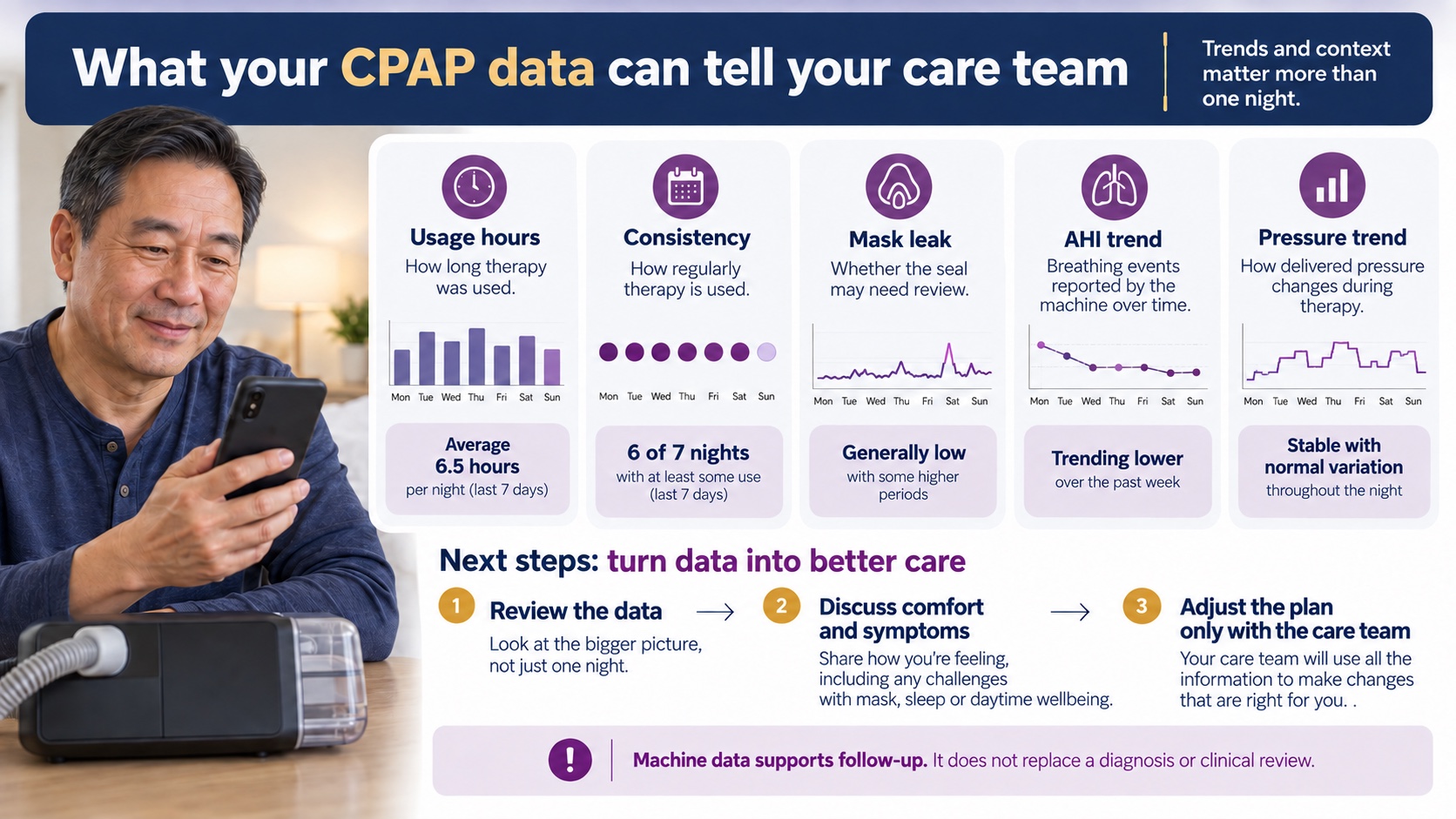
The exact report depends on the manufacturer, model, mode and software. Common fields include usage dates and hours, the percentage of nights or sleep periods used, pressure information, leak and an estimated residual apnea-hypopnea index (AHI). Some reports also show event categories, breathing patterns or summary trends.
These are treatment-monitoring estimates, not a repeat diagnostic sleep study. Most CPAP machines do not know how long you were actually asleep, and manufacturers may calculate leak and events differently. The American Thoracic Society notes that usage time is generally reliable, while intermediate leak and residual-event values require more caution and clinical context.
How to read common CPAP data fields
One unusual night rarely tells the whole story. Look for patterns across several nights and bring the report, symptoms and equipment concerns to the follow-up conversation.
What residual AHI can—and cannot—tell you
Residual AHI estimates the number of breathing events detected per hour while the device was running. It can help identify a pattern that deserves review, but the number is produced by the machine’s algorithm rather than by a technologist scoring sleep, airflow, effort and arousals in a diagnostic study.
A value should be interpreted alongside leak, actual sleep time, pressure pattern, event type, symptoms and the reason CPAP was prescribed. Large leak can make event detection and auto-adjusting responses less reliable. Do not change pressure settings or widen an APAP range solely to chase a number shown in an app.
Why early and ongoing follow-up matters
The AASM recommends adequate follow-up with troubleshooting and monitoring of objective efficacy and usage data after PAP treatment begins and throughout treatment. Early review is especially useful because mask fit, dryness, congestion, pressure discomfort, noise, anxiety and unclear setup instructions are often fixable. The CPAP Mask Guide can help organize fit questions, while CPAP Problems and Solutions covers common comfort barriers.
Follow-up is not only for the first month. Ask for review when symptoms return, weight or health changes substantially, treatment becomes difficult, equipment changes, or the report develops a persistent new pattern. Continuing daytime sleepiness also deserves attention because insufficient sleep, another sleep disorder, medication effects, mood or another health condition may be contributing even when CPAP use looks consistent.
A practical follow-up checklist
Do not drive or perform safety-sensitive work when struggling to stay awake. Persistent or worsening sleepiness should be discussed promptly even if the app gives a reassuring score.
- Bring or share a report covering a representative period rather than only your best night.
- Note bedtime, wake time, naps and how much of each sleep period included CPAP.
- Record the exact mask, tubing and device model, where a leak seems to occur and whether dryness, congestion, skin irritation or bloating is present.
- Describe changes in snoring, awakenings, morning headaches, alertness and daytime sleepiness.
- List new medicines, health changes, major weight changes, shift-work or travel barriers.
- Ask what each report field means for your exact machine and what follow-up interval is appropriate.
How virtual and remote support can help
Some machines transmit data through cellular or Wi-Fi services; others require an SD card, app export or an on-screen summary. With the appropriate account, connectivity, consent and care arrangement, remote data can help a provider identify missed use, leak or another pattern and focus a troubleshooting conversation.
Remote monitoring does not mean someone is watching continuously, that every problem creates an alert or that settings will be changed automatically. Before connecting a service, ask what data are collected, who can see them, why they are used, how long they are kept, whether information is shared with a manufacturer or payer, and how to withdraw consent where applicable. Canada’s privacy guidance emphasizes meaningful consent for the collection, use and disclosure of personal information.
Coverage and documentation in Canada
Public funding, private insurance and occupational or licensing programs can use different definitions, reporting periods and supplier requirements. Confirm the current rule directly with the specific program before relying on a threshold. Ask what document is required, who must provide it, what dates it must cover and what happens if early comfort problems reduce use.
Coverage documentation and clinical care answer different questions. Meeting a payer minimum does not prove that symptoms, leak or residual events are adequately controlled, while missing a threshold does not explain why treatment was difficult. A follow-up plan should address both the administrative requirement and the barrier to effective use.
Medical disclaimer
This content is educational and does not replace assessment, prescription, device-specific instructions or advice from a licensed healthcare provider.
Choose your next step
Complete guide: CPAP Therapy: A Complete Guide for Canadians