
Sleep health education
CPAP Pressure Settings Explained
Quick answer: CPAP pressure keeps your airway open during sleep. Your healthcare team selects the prescribed pressure or automatic pressure range using your assessment and treatment needs. If therapy feels uncomfortable or symptoms persist, ask your team to review the settings and mask fit instead of changing prescribed pressures yourself.
Sources: NHLBI

Expert perspective
Therapy data is most useful when it is considered alongside comfort, symptoms and the prescribed treatment plan. Settings should be reviewed with the care team rather than changed on the basis of one number alone.
How prescribed PAP pressure supports breathing
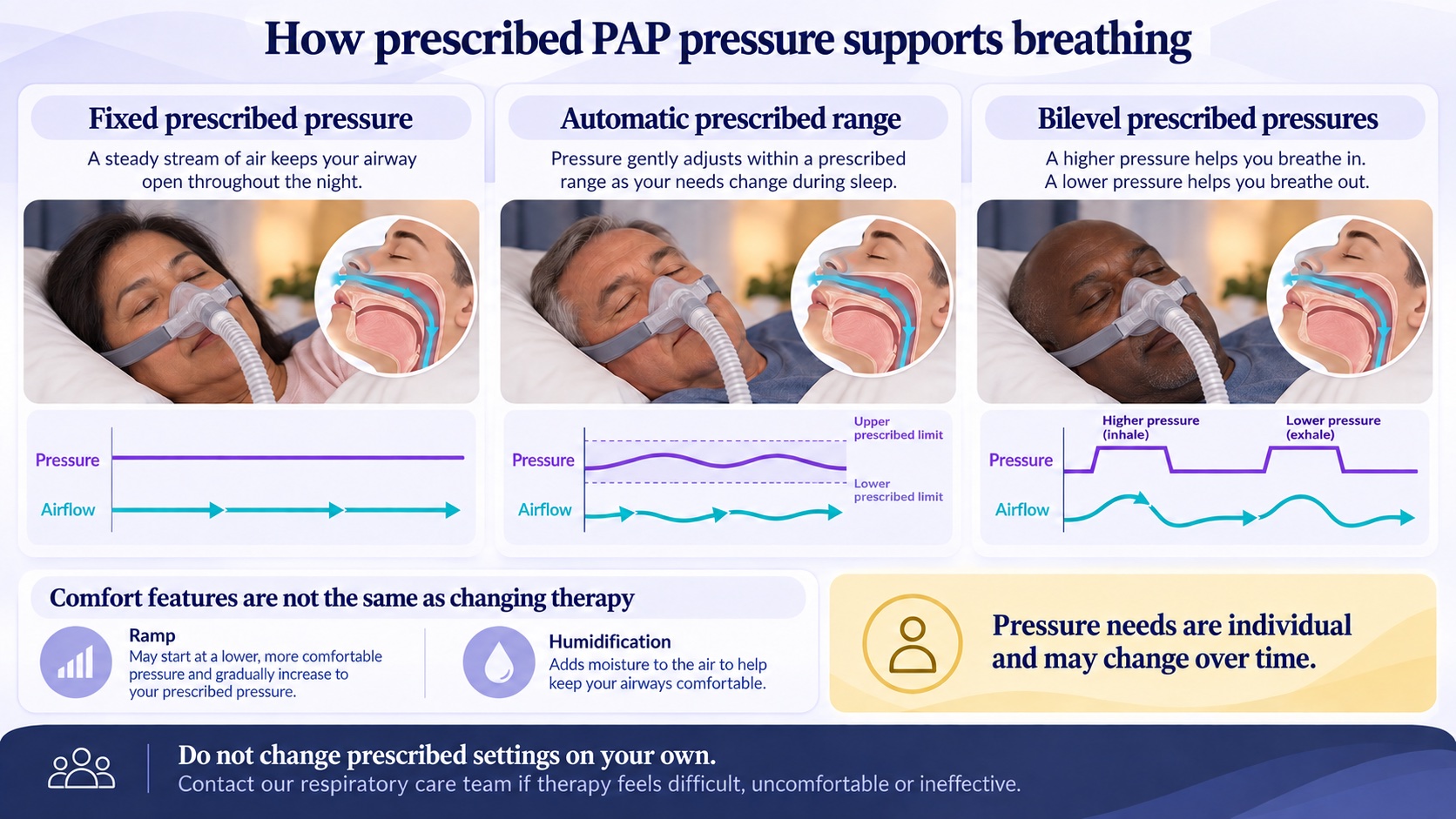
- Fixed PAP provides a steady prescribed pressure.
- Automatic PAP adjusts within a prescribed range.
- Bilevel PAP provides a higher pressure for breathing in and a lower pressure for breathing out.
- Do not change prescribed settings on your own.
What does cmH₂O measure?
CPAP and bilevel pressures are usually shown in centimetres of water pressure, written cmH₂O. The unit describes how much pressure could support a column of water. PAP devices use relatively mild positive pressure to help prevent the upper airway from narrowing or closing during sleep.
Pressure is not the same as oxygen. A standard CPAP device generally delivers room air at pressure unless separately prescribed oxygen is connected through an approved setup. Pressure is also different from flow: the machine changes airflow to maintain the intended pressure as you breathe and as leak changes.
Fixed CPAP, APAP and bilevel settings compared
The mode describes how the machine delivers pressure. It is not a ranking from basic to advanced, and one mode should not be substituted for another without clinical direction.
Read How CPAP Works for a broader explanation of airway support, or compare available device categories in CPAP Machines Canada.
What a fixed CPAP setting means
A fixed setting such as 10 cmH₂O means the device is intended to provide that prescribed treatment pressure after any ramp period, subject to the way enabled comfort functions operate. The number does not describe sleep apnea severity and cannot be compared with another person’s setting to decide whose condition is worse.
Fixed CPAP is not literally motionless airflow. The machine continually responds to inhalation, exhalation and leak to maintain pressure. A report may therefore display small variations or separate delivered-pressure information even when the prescribed treatment setting is fixed.
What an APAP range means
An APAP range has a prescribed minimum and maximum—for example, a minimum of 7 and maximum of 12 cmH₂O. The device can respond within those boundaries; it does not independently prescribe any pressure in its full factory-capable range. The minimum can matter because it is the pressure available before the algorithm detects and responds to changing breathing signals. The maximum is a boundary, not necessarily the pressure delivered all night.
APAP algorithms are manufacturer-specific. Responses can be influenced by the breathing signals the device detects, sleep position, rapid-eye-movement sleep, mask or mouth leak and other circumstances. A machine reaching the maximum does not prove that the maximum should be raised, just as remaining near the minimum does not prove the minimum should be lowered.
Understanding bilevel IPAP, EPAP and pressure support
Bilevel PAP provides a higher pressure during inhalation, called IPAP, and a lower pressure during exhalation, called EPAP. Pressure support is the numerical difference between IPAP and EPAP. For example, IPAP 12 and EPAP 8 cmH₂O produce pressure support of 4 cmH₂O.
These values have different physiological and comfort roles and must be interpreted with the prescribed bilevel mode. Some bilevel devices can also use timing, backup-rate, volume-targeting or auto-adjusting functions for particular conditions. Those settings are outside the scope of a general CPAP guide and require management by the responsible clinical team.
Common CPAP settings and report fields
Names and calculations differ across brands. Use the instructions and report definition for the exact device.
Ramp is not the same as APAP
Ramp is designed to make the beginning of a therapy session feel easier. It may start below the prescribed fixed pressure or APAP minimum and rise over a set time or according to a device-specific automatic-ramp feature. APAP, by contrast, adjusts treatment pressure within prescribed limits in response to detected breathing signals over the night.
If you repeatedly fall asleep before therapeutic pressure is reached, feel air hunger at the start, or wake when ramp ends, record the timing and discuss the comfort setup. Do not assume that making the ramp longer, shorter or lower is harmless for every person.
Expiratory relief is not bilevel PAP
Many CPAP or APAP devices can reduce pressure slightly during exhalation for comfort. Manufacturers use different names, levels and algorithms. This feature can make breathing feel easier, but it does not turn a CPAP machine into a prescribed bilevel device and should not be interpreted as equivalent to formal IPAP, EPAP and pressure-support settings.
Ask which comfort settings you are permitted to adjust and which require the treating provider or equipment team. If exhaling remains difficult, the solution may involve mask fit, nasal comfort, acclimatization, a comfort function or clinical reassessment rather than simply lowering treatment pressure.
Why pressure can feel too strong or too weak
The sensation of too much air can come from ramp ending, APAP increasing, mask leak, air entering the mouth, difficulty exhaling, anxiety, nasal dryness or congestion. A sense of too little air can occur at a low ramp start, with nasal obstruction, through an unsuitable interface or during acclimatization. These sensations are real, but they do not establish the correct pressure change.
Note when the feeling occurs, the mask and sleep position, dryness or congestion, leak, the pressure displayed and whether it settles while awake. Persistent bloating, painful air swallowing, chest discomfort, repeated awakenings or inability to use therapy should be discussed promptly. The CPAP Mask Leaks guide can help separate a pressure sensation from a seal or circuit problem.
How to read pressure with leak, residual AHI and symptoms
No single dashboard number confirms effective treatment. Large or persistent leak can affect APAP responses and reduce the reliability of residual-event estimates. A high residual AHI can reflect unresolved obstruction, central events, leak, limited use, awake breathing being misclassified or other factors that require clinical interpretation. A low app score cannot rule out persistent sleepiness, mask removal or inadequate sleep time.
Review several representative nights when possible. Look at how long therapy was actually used, whether it covered all sleep, leak patterns, pressure trends, residual-event information and changes in snoring, awakenings and daytime function. CPAP Adherence, Usage Data and Follow-Up explains how to prepare a useful report for review.
When settings may need clinical review
Review may be appropriate when symptoms persist or return, therapy becomes difficult to tolerate, leak cannot be resolved, residual data are repeatedly concerning, or there has been a material change in health, medication, weight, pregnancy, surgery, sleep position or alcohol use. The appropriate response might be troubleshooting, a mask change, data review, repeat testing or an authorized setting change; it cannot be determined from symptoms alone.
Bring the machine and mask model, current settings, a representative report, usual sleep schedule, symptoms and a timeline of what changed. If data transmit remotely, confirm who reviews them and when. Transmission does not mean someone is monitoring continuously or will automatically change treatment.
Do not change prescribed pressure from an online guide
Machine menus may expose settings that are intended for qualified setup. The fact that a device allows a change does not mean the change is clinically appropriate. Increasing or decreasing pressure can affect airway control, leak, comfort and the interpretation of subsequent data. It may also delay recognition of central breathing events, another sleep disorder or an equipment problem.
Use general education to prepare questions, not to rewrite a prescription. Follow the plan from the clinician or authorized provider responsible for therapy. If a setting was changed accidentally, record the original and current values if known and contact the provider rather than repeatedly experimenting.
When to seek prompt help
Contact the care team promptly if PAP causes severe or persistent bloating, painful air swallowing, marked breathing discomfort, repeated choking or inability to use prescribed therapy. Seek urgent medical care for severe difficulty breathing while awake, chest pain, fainting or another acute concern.
If sleepiness makes driving or safety-sensitive work unsafe, do not drive or continue the task. Pressure changes are not a substitute for prompt assessment of uncontrolled sleepiness.
Medical disclaimer
This content is educational and does not replace assessment, prescription, device instructions or advice from a licensed healthcare provider.
Choose your next step
Complete guide: CPAP Therapy: A Complete Guide for Canadians