
Home sleep testing pathway
How Does a Home Sleep Test Work?
Follow the Virtual Sleep Care pathway from online self-assessment through fingertip-sensor setup, multiple nights of recording, qualified interpretation and follow-up.
Quick Answer
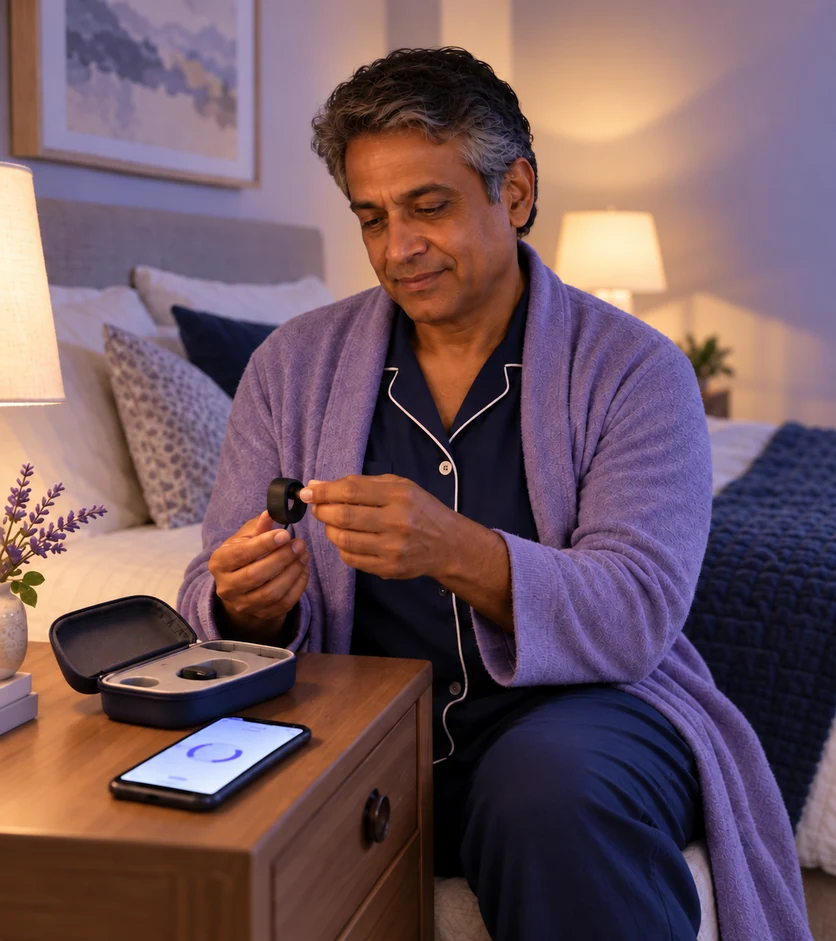
Virtual Sleep Care starts with an online self-assessment based on established clinical criteria. Eligible patients receive a small fingertip sensor that pairs with a mobile app and records multiple nights at home without a nasal cannula or chest belt. After the recordings pass a technical-quality check, a qualified clinician interprets the results and discusses the next step. A negative, inconclusive or technically inadequate study may require follow-up or laboratory testing.
What The Complete Process Includes
The home recordings are only one part of home sleep apnea testing. A reliable pathway begins with a clinical question and suitability decision, then connects device-specific setup and multiple representative nights with technical-quality review, qualified interpretation and a plan for each possible result.
Start To Finish
The Home Sleep Testing Pathway In Eight Steps
- Complete the online self-assessment. Review symptoms, sleep opportunity, work and driving safety, health history, medicines, previous testing and the diagnostic question.
- Confirm whether home testing is suitable. The assessment determines whether a home test can answer the question or whether laboratory polysomnography or another assessment is more appropriate.
- Verify the service before ordering. Confirm referral or prescription requirements, fees, coverage, what the service includes, cancellation terms and who is responsible for interpretation and follow-up.
- Receive the fingertip sensor and app instructions. Check the device, support contact, privacy information and what to do if the sensor is missing, damaged or will not connect.
- Prepare for representative nights. Follow the app and device instructions and keep the routine reasonably typical unless the responsible provider directs otherwise.
- Complete multiple nights of recording. Wear the fingertip sensor as instructed, start each recording in the app, sleep as normally as possible and note meaningful problems.
- Transmit the recordings. Follow the specified process so technical quality can be checked. Do not assume a completed upload means every recording is diagnostically adequate.
- Review the interpreted result and plan. Discuss data quality across the recordings, key indices, symptoms, limitations and the appropriate next step rather than relying only on an app or automated label.
Step 1: Start With The Clinical Question
Home sleep apnea testing is primarily used to help diagnose obstructive sleep apnea in appropriately selected adults. It does not measure every sleep stage, movement, behaviour, heart rhythm or neurological signal captured in a laboratory study. The first question is therefore not “Can I wear the device?” but “Can this test answer the concern safely and accurately enough?”
Bring specific observations: loud snoring, witnessed pauses, gasping, morning headaches, dry mouth, insomnia, daytime sleepiness, concentration problems, work schedule, total sleep opportunity and near-misses while driving. Review Who Is a Home Sleep Test For? before treating a home test as a universal first choice.
Step 2: Confirm The Service, Cost And Coverage
Before paying, ask whether the service includes suitability assessment, equipment use, delivery and return, technical-quality review, professional interpretation, a report, results consultation and referral onward when needed. A low advertised kit fee can be misleading if interpretation or follow-up is separate.
Canadian public and private coverage varies. Confirm the exact service, provider credentials, prescription or referral, approved supplier, pre-authorization and receipt requirements with the payer. Do not rely on a price or turnaround estimate unless the provider identifies what it includes and the conditions that affect it. Use home sleep test cost questions and the Insurance and Prescription Guide to verify the full pathway.
Step 3: Know What The Kit Records
Home sleep apnea tests record a limited set of breathing-related signals, but the exact signals differ by device category. Traditional systems may directly record airflow and breathing effort using a nasal sensor and chest belt. Virtual Sleep Care uses a small fingertip sensor and mobile app to derive or estimate breathing-related measures from signals such as peripheral arterial tone, oxygen saturation, pulse, movement and snoring.
These differences affect interpretation. Learn what each signal contributes in What Does a Home Sleep Test Measure? and how measurement limitations affect home sleep test accuracy.
Step 4: Prepare Without Trying To Influence The Result
Read the instructions before bedtime, confirm the support contact and identify each sensor while there is time to ask questions. Unless directed otherwise, follow a reasonably typical sleep schedule and do not deliberately stay awake, go to bed unusually early, use alcohol as a sleep aid or change prescribed medicines to make the result look better or worse.
The goal is a usable, representative recording—not a performance test. Use How to Prepare for a Home Sleep Test for the complete checklist.
Step 5: Complete Each Recording Night And Document Problems
Wear the fingertip sensor and start the recording in the mobile app exactly as directed. Follow the supplied instructions if the sensor comes loose, the app disconnects or a recording does not appear to complete.
Note approximate sleep and wake times, long awake periods, sensor or app problems, unusual illness, pain, alcohol or medicine changes and whether a night was highly atypical. One poor night does not necessarily determine the assessment because the service collects multiple nights, but every recording still undergoes a quality check.
Step 6: Technical Review Comes Before Interpretation
Returning the device or uploading data does not by itself mean the study succeeded. The signals must be checked for adequate recording time, sensor quality and whether enough interpretable data were captured. Automatic scoring can assist a workflow, but diagnosis should not rest on an unattended algorithm without qualified review.
A technically inadequate test may need repeating. When the data are usable but the result does not resolve the clinical concern, the next step may be different. Read What If Your Home Sleep Test Is Inconclusive?.
Step 7: Interpret The Report In Context
A report may include a respiratory event index, oxygen measures, pulse, position and signal-quality notes. The number of events is important, but it should be interpreted with symptoms, estimated sleep, recording limitations and the reason the test was ordered. A lower index does not automatically explain away severe sleepiness or witnessed breathing pauses.
Ask four questions: Was the recording technically adequate? What time measure was used in the index? Does the result fit the symptoms and history? What follow-up is recommended? See Understanding Sleep Study Results for common report fields.
Step 8: Plan For Positive, Negative And Inconclusive Results
Do not self-start treatment or choose pressure settings from a raw report. Review what happens after a home sleep test before the results visit.
When A Sleep Lab May Be The Better Route
Laboratory polysomnography can measure more signals and is preferred in some complex medical histories, suspected sleep disorders beyond uncomplicated obstructive sleep apnea, or when a home result does not answer the question. Being directed to a lab is not a judgment about symptom seriousness or how well someone prepared.
The decision should be made through clinical assessment rather than self-selection based only on convenience. Compare the two settings in Home Sleep Test vs. Sleep Lab.
Privacy And Data Questions To Ask
Before using a mailed, app-connected or cloud-connected test, ask what data are collected, where they are stored, who can access them, whether a third-party platform is involved, how long information is retained and how to request access or correction. Confirm whether support messages are monitored and do not use a routine test platform for emergencies.
Read the Privacy Policy and the service-specific consent information before submitting health information. A device connection does not imply real-time clinical monitoring.
Medical Disclaimer
This information is educational and does not replace assessment, diagnosis, prescribing, emergency care or individualized advice from a licensed healthcare professional.