
Quick answer
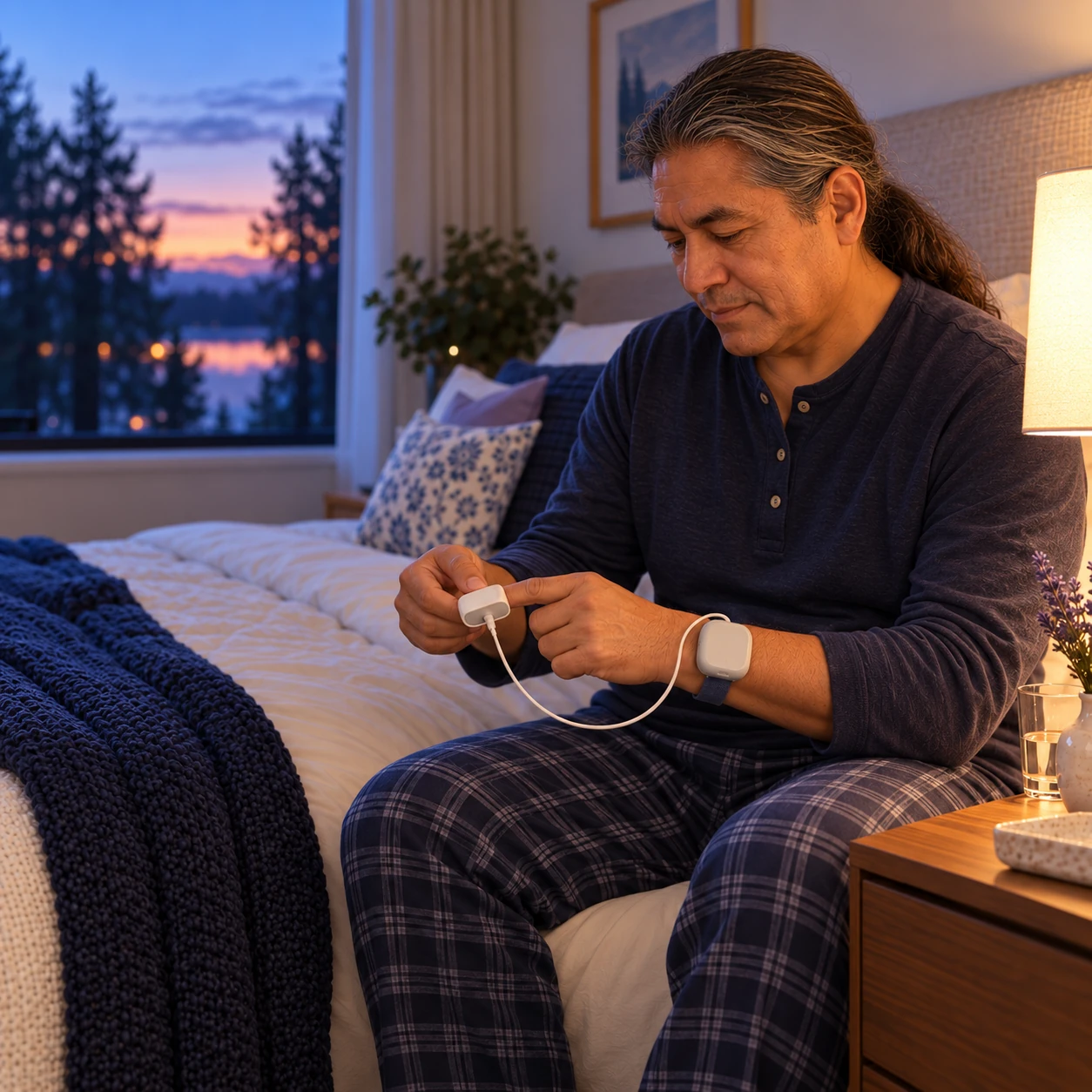
Depending on the device, a home sleep apnea test may record, directly or through indirect estimates, airflow, breathing effort, blood oxygen level, pulse or heart rate, body position, snoring and recording time. It generally collects fewer signals than an in-lab sleep study and may not measure brain waves or determine sleep stages, so results require qualified interpretation.
Airflow
Airflow may be measured directly using a nasal sensor, or estimated indirectly from a wrist-worn sensor, recorded breathing sounds, or both, depending on the device.
This helps the interpreting clinician identify changes in airflow during the recording. It is not a direct measure of how rested someone feels or a diagnosis by itself. Sensor position and contact matter, which is why the supplied setup instructions should be followed closely.
Breathing effort
Breathing effort may be measured directly using belts around the chest or abdomen, or estimated indirectly from other signals such as a wrist-worn sensor, depending on the device. Either approach helps distinguish reduced airflow from changes in effort.
Breathing effort is considered alongside airflow and other recorded signals. A single signal does not tell the complete story; the value comes from reviewing the pattern across the usable recording.
Blood oxygen
A finger or wrist-worn sensor may record oxygen saturation and pulse. Motion, circulation and poor sensor contact can affect the signal.
Oxygen information adds context to breathing events, but a single low or high value on a display should not be interpreted alone. The clinician checks the quality of the signal and looks at the overall pattern in the context of the selected test and symptoms.
Heart rate or pulse
Many devices record pulse or heart-rate information as part of the breathing assessment.
Pulse can help show how heart rate changed during the recording, but it does not diagnose a heart condition or explain a symptom by itself. Unexpected findings or concerns may need separate clinical assessment.
Position and snoring
Some devices record body position, movement or acoustic/vibration signals related to snoring.
These signals can provide useful context about when events occurred, but they do not make a diagnosis on their own. Whether position or snoring changes the next step is a clinical interpretation question, not a reason to change treatment based on a device summary.
What is often not measured
Many home studies do not record electroencephalography, eye movements, chin muscle tone or the full set of signals used to determine sleep stages and other sleep disorders.
Without those signals, many home tests cannot confirm exactly when a person is asleep in the way a laboratory polysomnogram, using brain-wave monitoring, can. Some home tests calculate their index using total recording time; others estimate sleep time to calculate an index closer to a laboratory AHI. Either way, the estimate is not identical to sleep time measured directly by brain-wave monitoring—one reason a laboratory study can be recommended when the question requires a broader view of sleep.
Read How Accurate Are Home Sleep Tests? for a deeper explanation of how recording time, patient selection and technical quality affect interpretation.
What the measurement limits mean in practice
Home sleep apnea devices commonly record a limited set of breathing-related signals, such as airflow, breathing effort, and oxygen saturation, measured directly or estimated indirectly depending on the device. The exact signals and reporting method differ by device. They do not collect every type of information available in an in-lab sleep study.
That limit is why the test must be selected and interpreted in clinical context. Ask what the selected device measures, what it may not measure, and whether a different study would be needed if the result does not explain symptoms.
When discussing results, ask what signals were captured, whether the recording was technically adequate, what the device could not measure, and how the findings fit the symptoms that led to testing. These questions make the limits transparent without making the result less useful.
Next, see how a home sleep test works, learn how to understand AHI and REI or use the practical guide to understanding your home sleep test results.