
Quick answer
A home sleep apnea test records a limited set of breathing signals at home and may be appropriate for selected adults with suspected uncomplicated obstructive sleep apnea. An in-lab polysomnogram records more signals under supervision and is often preferred when symptoms or medical conditions are complex, another sleep disorder is suspected, or a home test is negative or inconclusive despite ongoing concern.
Home sleep test and sleep lab compared
Neither option has one Canada-wide price or turnaround time. Services covered by provincial and territorial health plans vary, and private insurance depends on the individual policy. Confirm the current process, expected charges and reimbursement requirements before booking.
Convenience and environment
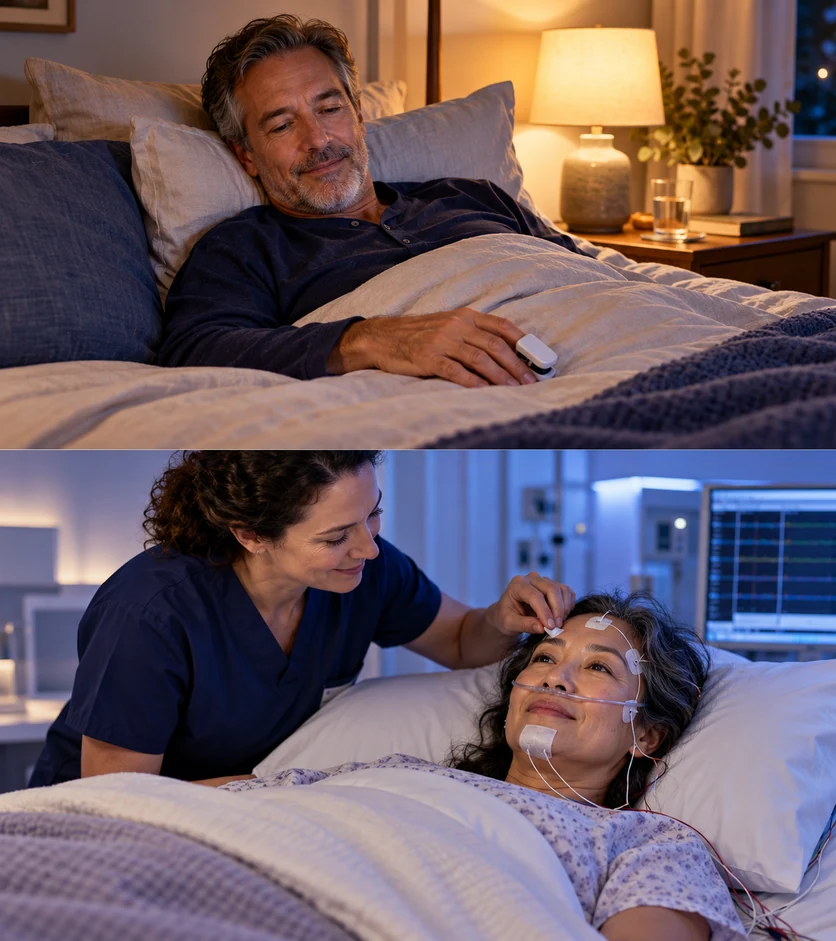
Home testing may feel more natural and avoids travel to a sleep lab, while a lab provides direct technical support and a controlled recording environment.
Breadth of information
A laboratory study can evaluate a wider range of sleep disorders and distinguish sleep from wake more precisely. Many home devices report a respiratory event index (REI) using recording time, while laboratory studies can calculate an apnea-hypopnea index (AHI) using confirmed sleep time. These related measures are not interchangeable, which is one reason results require clinical interpretation. Learn more about home sleep test accuracy and understanding AHI and sleep-study results.
That difference matters when the clinical question is broader than suspected uncomplicated obstructive sleep apnea. An in-lab study can record brain activity, eye movements, chin and leg movements, heart activity, breathing signals and oxygen levels. Those measurements help the sleep team understand sleep stages and investigate concerns that a limited home recording may not answer.
Who may need a lab
Complex medical conditions, suspected central sleep apnea or hypoventilation, severe insomnia, parasomnias, seizure concerns, movement disorders or persistent symptoms after a negative home test may justify laboratory testing.
This is not a checklist for self-selection. A clinician considers the full history, current symptoms, medicines, relevant health conditions and the question the test needs to answer. A laboratory study may also be the next step when a home recording has technical problems or does not explain persistent symptoms.
How the decision is made
The decision is usually made after a comprehensive sleep evaluation. For an uncomplicated adult with signs suggesting moderate-to-severe obstructive sleep apnea, either a home sleep apnea test or laboratory polysomnography may be appropriate. A home test is not a general screening tool, and the automatically generated result is not a standalone diagnosis.
A clinician can explain what the test can and cannot answer in your situation. Share details such as:
This information helps the clinician choose a test that can answer the clinical question safely.
- loud snoring, witnessed breathing pauses or gasping;
- daytime sleepiness or safety concerns related to alertness;
- insomnia, restless legs or unusual nighttime behaviours;
- opioid medicines or relevant heart, lung or neurologic conditions; and
- previous sleep-test results, including a negative or incomplete home recording.
Neither test is universally better
The better test is the one matched to the clinical question and patient circumstances. Convenience should not override diagnostic suitability.
Learn about the next step
Read the sleep apnea overview if you are still learning about symptoms, risks and diagnosis. Visit the home sleep testing guide for more detail about suitability, equipment, results and follow-up.
The clinician selects the test that best fits the symptoms, health history, prior testing and information needed.