
Canadian home sleep testing pathway
Home Sleep Test in Canada
Learn whether at home sleep apnea testing may fit your situation, what a complete service should include and which questions to answer before you proceed.
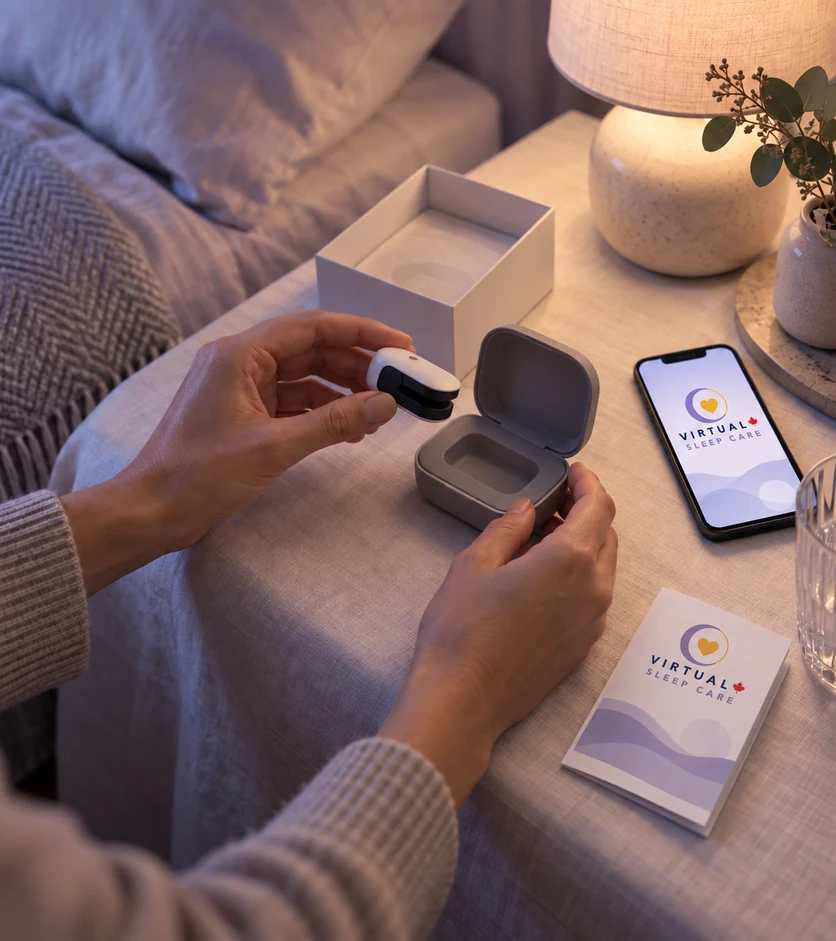
Home Sleep Apnea Testing: $165
Provided by NaviSleep Respiratory Solutions Inc. for appropriately selected adults with possible obstructive sleep apnea. The price includes the test device, 7 nights of recording, prepaid return shipping, physician interpretation and a virtual results appointment with a Registered Respiratory Therapist.
The diagnostic process usually takes 2–4 weeks, depending on when you start and complete testing. When results are ready, you book your results consultation; appointments are usually available within 1–3 business days. This diagnostic test is separate from monitoring included with CPAP care packages.
Available in Canadian provinces except Quebec. Coming soon to Quebec, Yukon, the Northwest Territories and Nunavut.
Quick Answer
Our home sleep apnea test costs $165: that is 50% off the regular $330 price, with no tax, and no referral is needed. We ship a small fingertip sensor that pairs with a mobile app. You record for 7 nights in your own bed, then send it back with the prepaid return label. An experienced sleep physician interprets your study with our respiratory therapist team, and you then meet a Registered Respiratory Therapist (RRT) to go through your results. The diagnostic sleep-testing process usually takes 2–4 weeks, depending on when you start and complete your trial. When your results are ready, you need to book your results consultation; appointments are usually available within 1–3 business days. Home testing can help diagnose obstructive sleep apnea in appropriately selected adults, but it is not a test for every sleep disorder.
Our Home Sleep Test at a Glance
| Price | $165, no tax. That is our 50% preferred-partner discount on the regular $330 price. |
|---|---|
| What is included | The test device is shipped directly to your door, prepaid return shipping included, interpretation by a sleep physician, and a virtual results appointment with a Registered Respiratory Therapist |
| Nights of recording | 7 nights, in your own bed |
| Device | A small fingertip sensor that pairs with a mobile app. It records blood oxygen, heart rate and breathing-related signals during sleep. |
| Referral needed? | No. You can order it yourself. |
| Who interprets it | An experienced sleep physician, who reviews the results with our Respiratory Therapist team |
| Your results | A virtual appointment with a Registered Respiratory Therapist (RRT). With your permission, a summary can be shared with your family doctor. |
| How long it takes | Usually 2–4 weeks for diagnostic testing, depending on when you start and complete the trial; book your results appointment when your report is ready |
| Who it is for | Adults 18 and older with symptoms of possible obstructive sleep apnea |
| Where it is available | Available in Canadian provinces except Quebec. Coming soon to Quebec, Yukon, the Northwest Territories and Nunavut. |
We provide the test with our partner NaviSleep. Ontario residents: the Assistive Devices Program only funds CPAP after an in-lab (Level 1) sleep study, so a home test result on its own will not qualify you for ADP funding. Many people instead use workplace or private insurance for CPAP. See CPAP funding by province.
Why We Record 7 Nights
Sleep apnea is not the same every night. Sleeping position, alcohol, a stuffy nose and how deeply you sleep can all change the number of breathing events from one night to the next. In one study of more than 10,000 people, about 1 in 5 people with mild or moderate sleep apnea were classified differently depending on which single night was scored. Recording several nights gives the sleep physician a more reliable picture, particularly when results are borderline. Read more in can one night of testing miss sleep apnea?
How It Works
- Order your test here; NaviSleep then emails you a short intake and consent form.
- NaviSleep ships the device to your door with a prepaid return label.
- Sleep with the sensor for 7 nights, following the app’s instructions.
- Send the device back. A sleep physician interprets your recording and reviews it with our Respiratory Therapist team.
- Meet a Registered Respiratory Therapist to go through your results and next steps, such as CPAP therapy, an oral appliance or other options.
Understand Your Home-Testing Options
Before choosing a home sleep test, understand who it may suit, what it records, its limitations, costs and follow-up. Convenience alone does not make home testing the right option for everyone.
Use the focused guides when you need more detail about one decision. For the end-to-end pathway, read How Does a Home Sleep Test Work?; the sections below also link directly to suitability, accuracy, preparation, results, costs and insurance guidance.
Start here
Who May Be Considered For a Home Sleep Apnea Test?
Home testing is commonly considered for an adult whose symptoms and clinical assessment suggest uncomplicated obstructive sleep apnea. Relevant patterns can include habitual loud snoring, witnessed breathing pauses, gasping or choking during sleep, morning headaches, waking with a dry mouth and excessive daytime sleepiness.
Symptoms alone do not select the test or establish a diagnosis. Virtual Sleep Care uses an online self-assessment based on established clinical criteria to review the reason for testing, sleep opportunity, work and driving safety, medicines, previous testing and relevant health conditions before a kit is sent. Use Who Is a Home Sleep Test For? for the more detailed suitability guide.
When Home Testing May Not Be Enough
Laboratory polysomnography records more signals and may be more appropriate when the clinical question is complex, another sleep disorder is suspected or a previous home study was negative, unclear or technically inadequate despite continuing concern. A qualified provider may also favour laboratory testing when significant cardiorespiratory disease, suspected central sleep apnea or hypoventilation, neuromuscular weakness, chronic opioid use, previous stroke or severe insomnia could affect test selection or interpretation.
These examples are not a self-screening exclusion list. The choice depends on the whole clinical picture. A home test generally does not provide the same sleep-stage, neurological, movement and broader physiological information as a laboratory study. Being directed to a sleep lab is not a sign that a person prepared poorly or that their symptoms are being dismissed. Compare the options in Home Sleep Test vs. Sleep Lab.
What a Home Sleep Test Records
Home sleep apnea devices differ. Some directly record airflow and breathing effort with nasal sensors and belts. Other validated systems use a wrist-worn sensor and app to derive or estimate breathing-related measures from signals such as peripheral arterial tone, oxygen saturation, pulse, movement and snoring.
Virtual Sleep Care’s test uses a small fingertip sensor and a mobile app; it does not require a nasal cannula or chest belt. The exact device, signals and scoring method matter. Read What Does a Home Sleep Test Measure? and How Accurate Are Home Sleep Tests? before treating all home tests as interchangeable.
A Home Sleep Test is Not the Same as a Consumer Wearable
A smartwatch, ring, phone application or consumer sleep tracker may estimate sleep or flag patterns, but it does not replace a medically selected home sleep apnea test and qualified interpretation. Consumer scores can be useful context to discuss, yet they may use different sensors, algorithms and definitions and should not be used to diagnose sleep apnea or choose treatment.
If a consumer device reports repeated oxygen changes, breathing disturbances or poor sleep, bring the trend and the exact device name to an assessment. Symptoms, safety risks and clinical history still determine the appropriate next step.
What a Complete Home-Testing Service Should Clarify
Before You Book: A Practical Checklist
- Write down the main nighttime and daytime symptoms, when they began and whether someone has observed snoring, gasping or breathing pauses.
- Note safety-sensitive work, drowsy-driving concerns, usual sleep hours, shift work and whether the planned test night is likely to be typical.
- Prepare relevant diagnoses, medicines, previous sleep studies and current sleep or breathing treatments for the suitability assessment.
- Confirm whether the service is available in your province or territory and whether a referral, prescription or pre-authorization is required.
- Ask for the total fee, what is included, expected delivery and results timing, repeat-test terms and the support contact for test night.
- Read the privacy and consent information before sending health information or connecting a device or application.
How home testing works
From Symptom Check to Results Review, Without a Sleep Lab
Angela Hoffman, RRT, CRE explains each step: the quick online symptom check, a small device mailed to you and worn for 7 nights in your own bed, results interpreted by a sleep physician, and an unhurried video review with a sleep clinician. (57 s, captioned)
Read the video transcript
So here’s how it works. If you’re not sure whether you have sleep apnea, or maybe it’s been years since you were diagnosed or last tested, you can start with our quick online symptom check. It only takes a few minutes, and if your answers point to possible sleep apnea, you can order a test right there. After that, we’ll mail you a small, simple device to use. You wear it for five to seven nights in your own bed, not a lab and not a hospital. You’ll get clear instructions on how to use it, and if you get stuck, you can actually reach a real person on our team. Once you’re done your testing, a sleep physician will interpret your results. Then you’ll meet with a sleep clinician by video to go through your report together. There’s no rushing. You’ll have time to ask questions, and time to actually understand what’s going on, because we believe that education is the first step in getting real results.
The Home Sleep Testing Process
- Complete the online self-assessment. Describe symptoms, sleep schedule, safety risks, health history and the reason a test is being considered.
- Confirm suitability and requirements. The assessment determines whether home testing fits and whether a referral, prescription, pre-authorization or other documentation is needed.
- Review the service and consent information. Confirm costs, inclusions, privacy practices, equipment terms and support contacts.
- Receive the fingertip sensor and app instructions. Check the kit before the first recording night and ask questions while support is available.
- Complete multiple representative nights. Follow the app and device instructions without trying to make the results look better or worse.
- Transmit the recordings. Follow the stated process and report meaningful device or sensor problems.
- Wait for technical and clinical review. The recordings must be checked for quality and interpreted in context.
- Discuss the result and plan. Confirm what the findings support, what remains uncertain and who is responsible for the next step.
For the full step-by-step explanation, see How Does a Home Sleep Test Work?.
Preparing For Test Night
Read the instructions in advance, identify each sensor, check whether the equipment requires charging and save the support contact. Unless the responsible provider tells you otherwise, keep the evening reasonably typical. Do not deliberately restrict sleep, use alcohol to force sleep or change prescribed medicines to influence the recording.
The goal is a usable representation of your usual sleep—not a perfect performance. Note approximate sleep and wake times, long awake periods, unusual illness or pain and any sensor problems. Use the complete home sleep test preparation checklist.
Results Are More Than One Number
A report may include REI or AHI, oxygen measures, pulse, snoring, body position, usable recording time and technical-quality notes. A qualified professional should explain which time measure was used, whether the recording was adequate and how the findings fit your symptoms and health history.
A low or negative index does not automatically explain away severe sleepiness or witnessed breathing pauses. Review common fields in Understanding Your Home Sleep Test Results, learn about AHI and REI, or prepare for a home sleep test results consultation.
Cost, Insurance and Referral Questions In Canada
Fees and public or private coverage vary by province, territory, provider and benefit plan. Before proceeding, confirm the total price and whether it includes suitability review, equipment use, delivery and return, interpretation, a written report, results consultation, repeat testing and applicable taxes.
Ask the insurer or public program whether a referral, prescription, pre-authorization, approved provider, service code or specific receipt is required. Written confirmation reduces surprises but does not guarantee reimbursement. See How Much Does a Home Sleep Test Cost in Canada?, Is a Home Sleep Test Covered by Insurance? and the Insurance and Prescription Guide.
Privacy and Connected Devices
Ask what personal and health information is collected, where it is stored, who can access it, whether third-party apps or cloud platforms are used, how long records are retained and how you can request access or correction. Confirm how identity is verified for virtual care and how the device is cleaned and prepared between users.
A connected device or uploaded recording does not mean someone is monitoring you in real time. Do not use routine portal messaging or test equipment for an emergency. Review the Privacy Policy and service-specific consent before submitting health information.
Safety While You Consider Testing
Raise severe daytime sleepiness, near-misses, workplace risk or difficulty staying awake while driving during the assessment rather than waiting for a test result. Do not drive or operate dangerous equipment when struggling to remain alert.
Seek urgent or emergency care for severe breathing difficulty, chest pain, stroke-like symptoms, loss of consciousness or another emergency. A home sleep test is not emergency monitoring and should not delay appropriate care.
Consider the next step
Review Whether the Home-Testing Pathway Fits
Bring your symptoms, sleep schedule, health history, safety concerns and coverage questions. Confirm the consultation scope and fees before submitting health information or booking.
Medical Disclaimer
This information is educational and does not replace individualized assessment, diagnosis, treatment or emergency care from an appropriately qualified healthcare professional.