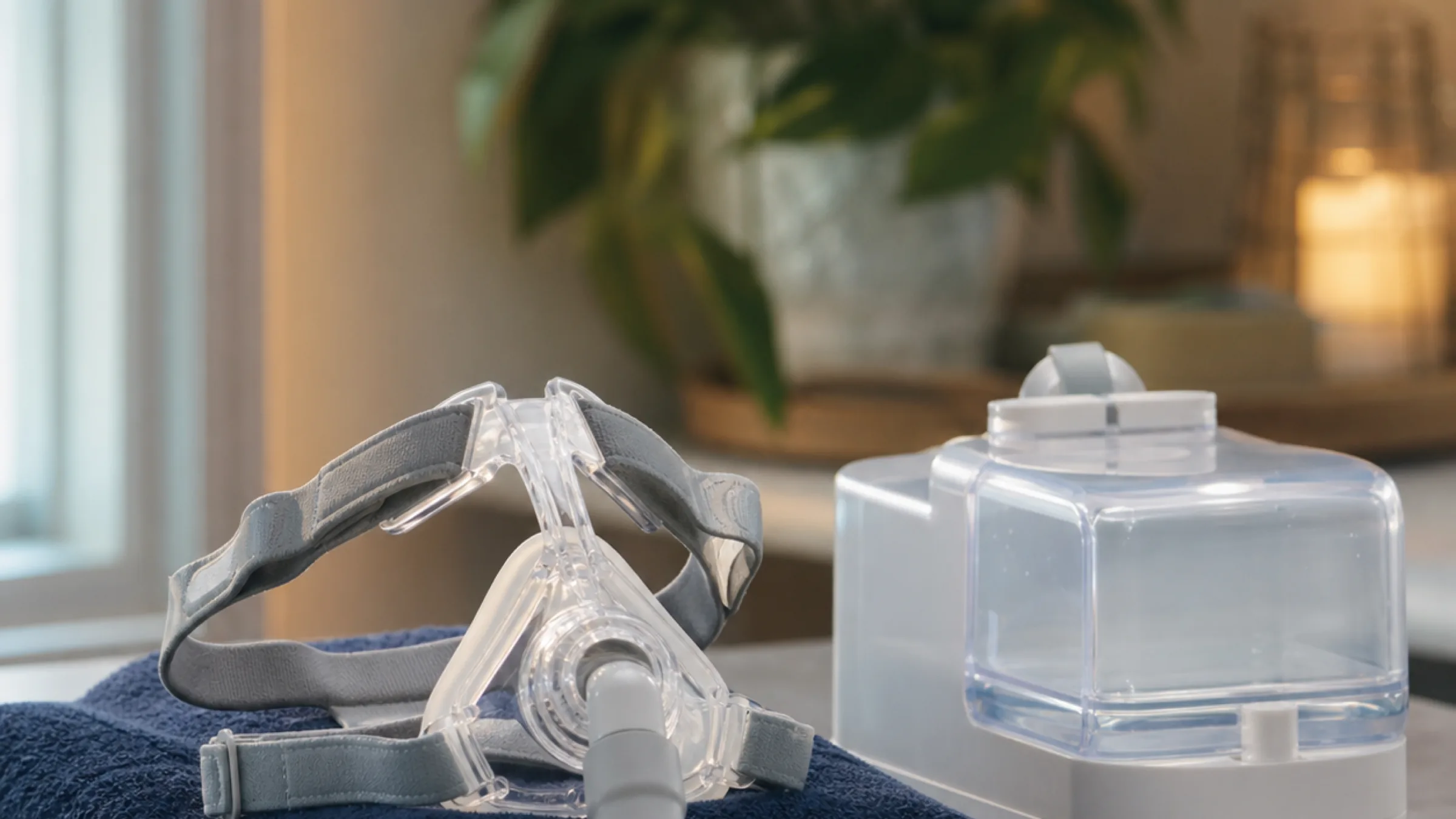
A full-face mask delivers prescribed positive airway pressure through both the nose and mouth. It may be considered when a reliable oral route is needed, but mouth breathing or nasal congestion does not automatically make it the best choice. The exact design still needs a stable, comfortable seal while lying down with therapy running.
30-day mask exchange: if a mask you buy from us does not fit, you can exchange it once for a different size or style within 30 days of delivery. See the conditions.
A larger breathing route still requires an individual fit
Identify the reason
Recurring mouth breathing, nasal obstruction and prescribed pressure deserve assessment rather than an appearance-based choice.
Compare facial contact
Traditional over-the-nose and under-the-nose designs contact different areas and can leak differently.
Check safety and support
Confirm current instructions, magnet warnings, Canadian authorization, parts, returns and fitting help for the exact model.
Traditional and under-the-nose full-face masks compared
Common full-face CPAP mask design considerations
Design
Facial contact
Potential advantage
What to check
Traditional full-face
Usually seals around the nose and mouth.
A familiar design with a broad oral and nasal route.
Nose-bridge pressure, air toward the eyes, jaw movement, pillow contact and field of vision.
Under-the-nose full-face
Sits beneath the nostrils and seals around the mouth.
May reduce nose-bridge contact and leave more of the upper face open.
Nostril alignment, corner-of-mouth leak, jaw movement, sizing and stability when turning.
Hybrid or model-specific design
Coverage and seal geometry vary by manufacturer.
May address a particular contact or visibility preference.
Exact instructions, component compatibility, venting, pressure limits and available replacement parts.
These are categories, not rankings. Compare other interfaces in CPAP Mask Types or browse the broader CPAP Masks Canada collection.
Expert perspective
A mask should feel secure without needing to be overtightened. Persistent leaks, pressure points or dry mouth are useful signals to review the mask style, size, fit and therapy setup rather than simply trying to tolerate the problem.
Angie Cummings , BSc, RRTCPAP therapy and equipment
When a full-face mask may—and may not—help
A full-face interface may be discussed when persistent mouth opening causes clinically significant leak with a nasal interface, when nasal breathing is not dependable, or when the prescribed plan calls for an oral and nasal route. It may also feel reassuring during temporary congestion for some people.
It does not treat the cause of nasal obstruction, guarantee less dry mouth or prevent every leak. Facial contact, jaw movement and a larger seal perimeter can introduce different fit challenges. Do not tape the mouth, change prescribed pressure or switch interfaces solely on general online advice.
An eight-point full-face mask fitting check
Confirm the exact model and size. Sizes are not standardized across brands or generations.
Read current instructions and warnings. Identify vents, quick-release features, magnetic components and contraindications.
Assemble the complete circuit. Confirm the elbow, frame, cushion, headgear and tubing connection.
Position before tightening. Centre the cushion according to its guide and adjust straps evenly.
Turn therapy on. Judge the seal at the prescribed setup, not with the machine off.
Lie in usual sleep positions. Move your head and relax your jaw while checking the nose, cheeks and mouth corners.
Separate vent flow from leak. The intentional exhalation vent must remain open; escaping air around the cushion or a connection is different.
Recheck after representative use. Pain, skin injury, eye irritation, persistent dryness or high leak deserves support rather than repeated overtightening.
Common leak patterns and safer first checks
Full-face mask leak patterns
What you notice
Possible contributor
First check
Air near the eyes
Upper seal position, size, cushion wear or pillow contact
Reposition with airflow on and inspect the cushion before tightening.
Leak at the mouth corners
Jaw movement, lower seal alignment or size
Relax the jaw while lying down and make small, even adjustments.
Seal changes when side sleeping
Pillow contact, tubing pull or frame movement
Repeat fitting in that position and route tubing to reduce pull.
Pain or broken skin
Excess tension, pressure concentration or unsuitable shape
Stop overtightening and request timely fitting support.
Dry mouth despite a full-face mask
Leak, humidity, nasal symptoms, medicines or another cause
Record the pattern and review fit, humidity and relevant health factors.
Some masks use magnetic headgear clips. Magnets can interfere with certain implanted medical devices or metallic objects in the body, including for a bed partner, caregiver or another person close to the mask. Read the current instructions and recall information for the exact model and discuss any implant or metallic object with the responsible healthcare professional before use.
Do not transfer a warning, distance or contraindication from one mask to every other model. If the current instructions identify a contraindication, arrange an appropriate non-magnetic alternative with the care team.
Compatibility, parts and buying in Canada
A 22 mm tubing connection does not prove complete compatibility. Confirm the machine, circuit, mask-type setting if applicable, pressure range, intentional venting, anti-asphyxia valve or other safety features, and the exact cushion, frame, elbow, clips and headgear for that model and generation.
Before buying, verify current Health Canada authorization where required, seller identity, package contents, fitting or return policy, Canadian warranty, replacement-part availability and whether professional setup or follow-up is included. Hygiene-related return restrictions can matter once a package is opened.
Insurance and replacement questions
Coverage differs by province, territory and private plan. Ask whether the mask and replacement components are eligible, whether a prescription or approved supplier is required, what frequency or dollar limits apply and what must appear on the receipt. Reimbursement timing is not a universal clinical replacement schedule.
It delivers positive airway pressure through both the nose and mouth. Designs may cover the nose or sit beneath it while sealing around the mouth.
Do mouth breathers always need a full-face mask?
No. The pattern and cause of mouth breathing, nasal comfort, prescribed therapy, leak and available alternatives should be reviewed together.
Is a full-face CPAP mask better for high pressure?
Not automatically. Pressure tolerance, seal, comfort and mask design vary. Choose according to the prescribed plan and an individual fitting rather than a pressure rule alone.
Why does my full-face mask leak near my eyes?
Upper-cushion position, size, wear, overtightening, sleep position or pillow contact can contribute. Refit with airflow on while lying down.
Can a full-face mask still cause dry mouth?
Yes. Leak, humidity, nasal symptoms, medicines and other causes may contribute. Dry mouth does not prove the mask or pressure is responsible.
Can I wear glasses with a full-face CPAP mask?
Some low-profile designs leave more of the upper face open, but glasses should not interfere with the seal or block the vent. Test the exact mask and routine.
Are magnetic full-face masks safe with an implant?
Do not assume they are. Read current warnings for the exact model and discuss implanted devices or metallic objects affecting you or a nearby person with the responsible healthcare professional.
Are full-face CPAP masks covered by insurance in Canada?
Coverage varies. Confirm prescription and supplier rules, eligible components, frequency limits, maximums and receipt requirements before purchase.
Yuwell YF-06 instructions, licence and controlled product records. Exact supplied instructions remain the primary source for fit, warnings, compatibility, care and replacement.
Fit and product support
Choose a full-face mask for a defined need
Bring the machine model, prescribed setup, breathing route, sleep position, implant information and current leak or comfort pattern to a fitting conversation.
To provide the best experiences, we use technologies like cookies to store and/or access device information. Consenting to these technologies will allow us to process data such as browsing behavior or unique IDs on this site. Not consenting or withdrawing consent, may adversely affect certain features and functions.
Functional
Always active
The technical storage or access is strictly necessary for the legitimate purpose of enabling the use of a specific service explicitly requested by the subscriber or user, or for the sole purpose of carrying out the transmission of a communication over an electronic communications network.
Preferences
The technical storage or access is necessary for the legitimate purpose of storing preferences that are not requested by the subscriber or user.
Statistics
The technical storage or access that is used exclusively for statistical purposes.The technical storage or access that is used exclusively for anonymous statistical purposes. Without a subpoena, voluntary compliance on the part of your Internet Service Provider, or additional records from a third party, information stored or retrieved for this purpose alone cannot usually be used to identify you.
Marketing
The technical storage or access is required to create user profiles to send advertising, or to track the user on a website or across several websites for similar marketing purposes.