
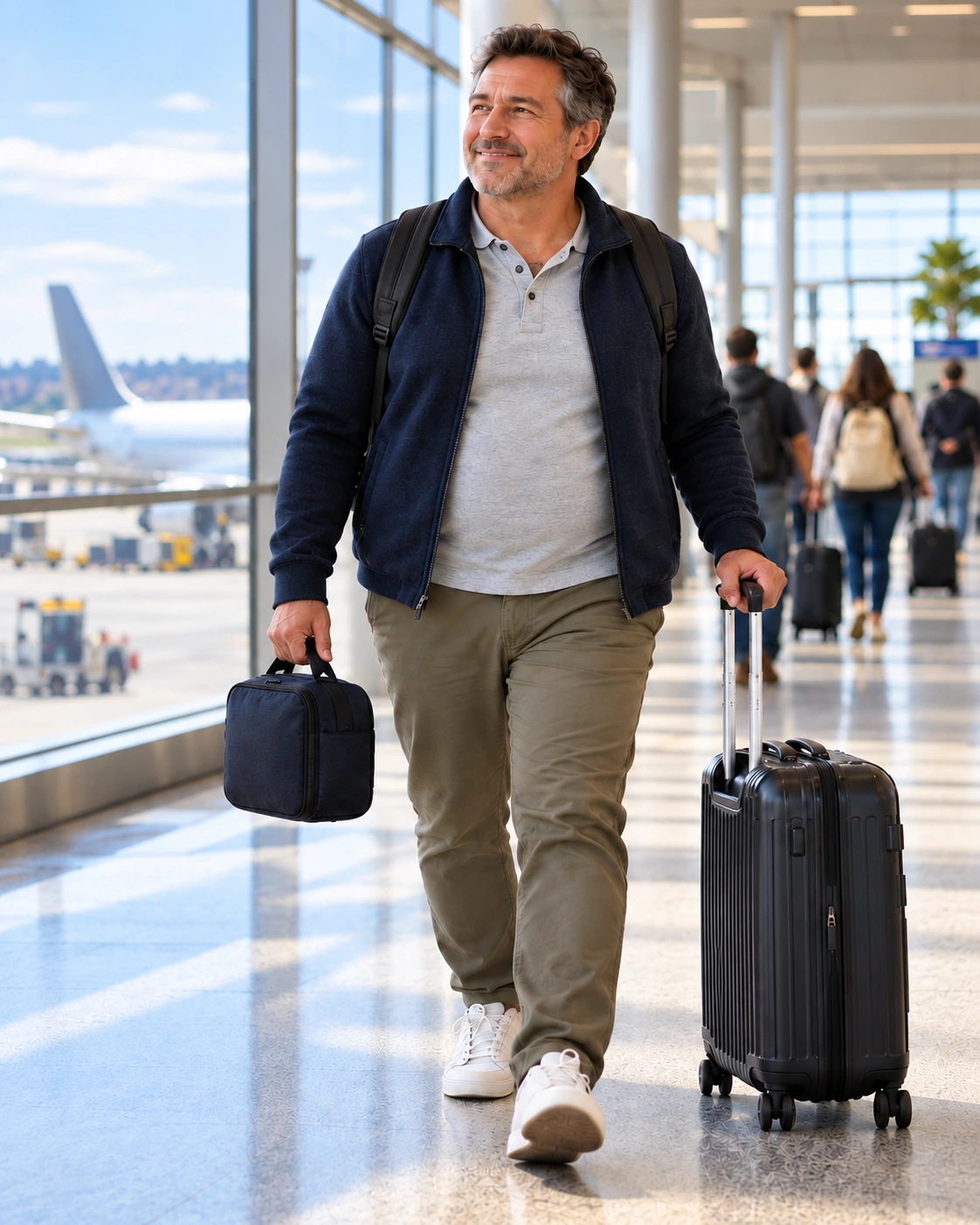
Quick answer
A travel CPAP machine is a small, portable CPAP that delivers the same prescribed therapy as a home machine. We sell the Yuwell BreathCare Pocket S ($1,200), which weighs 355 grams, runs on 100 to 240 volt power and uses a built-in waterless HME (heat and moisture exchanger) instead of a water chamber. Other travel machines, such as the ResMed AirMini, are a similar size; we don’t currently sell ResMed products. Pair one with a battery of 100 Wh or less, such as the 98 Wh Medistrom Pilot Flex, if you want to use it on a plane or off-grid.
Shop travel CPAP machines
Prices are in Canadian dollars. A prescription is required for CPAP therapy.
At a glance
Key takeaways
Travel CPAPs weigh about 300 to 355 grams and deliver the same prescribed therapy as a home machine.
They use waterless humidification, which is lighter and spill-free but may feel less humid than a heated water chamber.
Check mask and tubing compatibility: the AirMini uses its own tubing and AirMini-compatible masks, while the Pocket S takes standard tubing.
For flights and camping, choose a CPAP battery rated 100 Wh or less so it can go in your carry-on without airline approval.
Do you need a travel CPAP?
Not always. Your home CPAP can travel with you, and many people take it on road trips and flights. A travel CPAP makes the most sense if you:
- fly often and want a lighter carry-on
- camp, boat or travel off-grid and need to run on a battery
- want a backup machine in case your home machine needs repair
- travel for work and set up in a different room several nights a week
If you mainly sleep at home and travel once or twice a year, a travel bag for your home machine may be enough. See the CPAP buying guide and CPAP machine comparison for home machines.
How to choose a travel CPAP machine
- Prescription and pressure: the travel machine must deliver your prescribed therapy. Auto machines adjust within a set range; your settings should match what your clinician prescribed.
- Mask and tubing: the AirMini works only with AirMini tubing and AirMini-compatible masks. The Pocket S uses standard CPAP tubing, so it works with most masks you already own. See the CPAP mask guide.
- Humidification: travel CPAPs use waterless heat-moisture exchangers. If you rely on a heated humidifier at home for a dry mouth or nose, try the travel setup at home before a long trip. See dry mouth with CPAP.
- Battery options: check which batteries and DC cables work with the machine, and their watt-hour rating.
- In-flight use: if you want to sleep with CPAP on a plane, check the manufacturer’s FAA compliance statement and your airline’s rules.
- Data and support: both machines use a mobile app. Ask how therapy data is shared with your care team and what the warranty covers.
CPAP batteries for travel
A CPAP battery lets you use your machine on a plane, while camping or during a power outage. The Medistrom Pilot Flex ($499) is a 98 Wh battery, just under the 100 Wh carry-on limit, and includes an AirMini DC cable; other machines need a brand-specific cable, sold separately. Airline battery limits from CATSA:
| Lithium-ion battery size | Carry-on |
|---|---|
| 100 Wh or less | Allowed |
| 101 to 160 Wh | Only with airline approval; maximum 2 spares |
| Over 160 Wh | Not allowed |
Spare lithium batteries must never go in checked luggage (Transport Canada). Tape the terminals or keep each spare in its own bag. Battery life is much longer with humidification and heated tubing turned off; Medistrom’s runtime estimates assume both are off (Medistrom). Do a test night at home to learn how long your battery lasts at your pressure.
Flying with a travel CPAP
CATSA allows CPAP machines in carry-on bags, and distilled water for your CPAP is exempt from the 100 ml liquid limit (CATSA). Air Canada and Porter carry CPAP machines in addition to your normal baggage allowance at no charge. To use CPAP on board, contact your airline at least 48 hours ahead (Air Canada asks for 48 hours, or 72 hours for some destinations) and bring enough battery power, because seat power is not guaranteed.
For airline-by-airline rules, screening tips and what to do on the plane, read our full guide to travelling with CPAP.
Power and plugs abroad
The AirMini and Pocket S power supplies are rated 100 to 240 volts, 50 to 60 hertz, so they generally work abroad with only a plug adapter. ResMed advises packing an appropriate adapter plug (ResMed). Check the label on your power supply before you travel, and bring an extension cord because outlets are not always near the bed.
Camping, road trips and off-grid use
DC converters let many CPAP machines run from a 12 V or 24 V source in a car, boat or RV (ResMed). A dedicated CPAP battery is safer than an improvised power source. The Pilot Flex can be recharged from AC power, USB-C, a car charger or a solar panel (Medistrom).
Travel CPAP packing checklist
- Travel CPAP and power supply
- Mask, cushion, headgear and tubing, plus a spare cushion
- Waterless humidifier cartridges (HumidX or HME)
- Plug adapter and extension cord
- Charged battery and DC cable, in your carry-on
- A copy of your prescription and a letter from your doctor
- The manufacturer’s FAA compliance letter if you plan to use CPAP on board
Keep cleaning your mask and tubing while you are away; see how to clean CPAP equipment.
Sources
- ResMed. AirMini device fact sheet. https://document.resmed.com/documents/products/machine/airmini/fact-sheet/1019980r4+AirMini+Device+Fact+Sheet+EMEA+Eng+LOW.pdf
- ResMed UK. Travelling with CPAP. https://www.resmed.co.uk/patient/living-with-sleep-apnoea/travelling-with-cpap/
- ResMed. Travelling with your equipment. https://www.resmed.com.au/healthcare-professionals/support/treatment-and-maintenance/traveling-with-your-equipment
- CATSA. Continuous positive airway pressure (CPAP) device. https://www.catsa-acsta.gc.ca/en/what-can-bring/item/continuous-positive-airway-pressure-cpap-device
- CATSA. Guidelines for batteries. https://www.catsa-acsta.gc.ca/en/what-can-bring/guidelines-batteries
- Transport Canada. Lithium batteries, part 2: what you didn’t know about travelling with them. https://tc.canada.ca/en/tc-stories/lithium-batteries-part-2-what-you-didn-t-know-about-travelling-them
- Air Canada. Special needs and medical devices. https://www.aircanada.com/content/dam/aircanada/portal/html/dailog-box/booking-flow/special-needs_en.html
- Porter Airlines. Carry-on allowance. https://www.flyporter.com/en-us/travel-information/baggage/carry-on-allowance
- Medistrom. Pilot-24 Lite. https://www.medistrom.com/products-pilot24-lite.html
- Medistrom. Pilot Flex features. https://www.pilotflex.com/features
Disclaimer
This page is general health information, not medical advice, and it does not replace an assessment by a qualified health professional. Virtual Sleep Care does not currently serve Quebec, Yukon, the Northwest Territories or Nunavut. Airline and security rules change; confirm current requirements with your airline and CATSA before you travel.
ResMed, AirMini and HumidX are trademarks of ResMed Ltd. or its affiliates. Yuwell and other product names are trademarks of their respective owners. Virtual Sleep Care is not currently an authorized ResMed retailer and does not sell ResMed products. ResMed products are described for independent educational information only, using ResMed’s published information, which does not imply affiliation with or endorsement by ResMed.