
Sleep health education
Untreated Sleep Apnea: Risks and Next Steps
Quick answer
Untreated sleep apnea can impair sleep quality, alertness, concentration and quality of life. It is also associated with high blood pressure, cardiovascular disease, stroke, metabolic disease and motor-vehicle or workplace injuries related to sleepiness. Association does not mean every person will develop these problems, but persistent symptoms deserve assessment.
Why untreated sleep apnea deserves attention
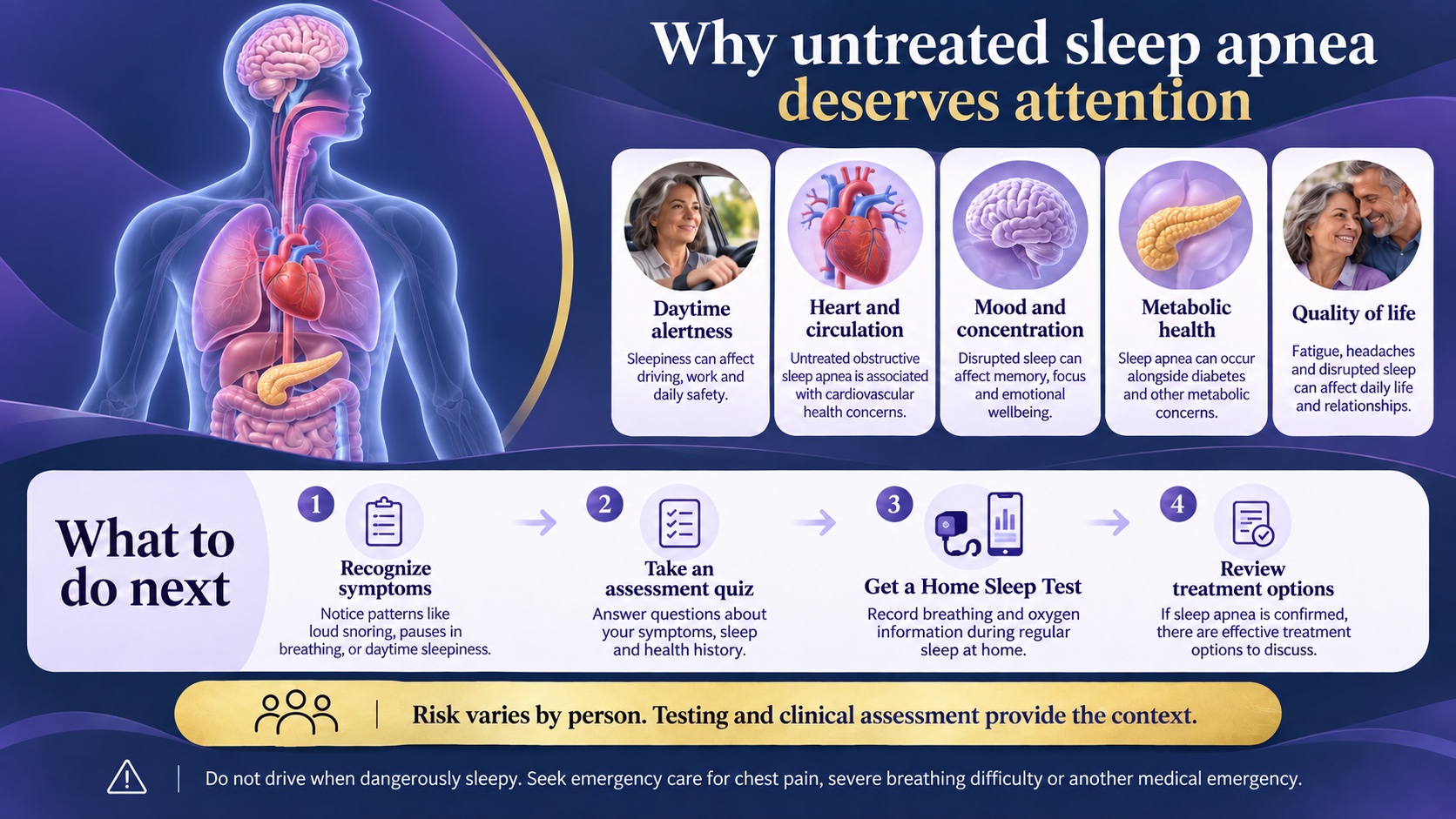
- Risk varies by person; testing and clinical assessment provide context.
- Recognize symptoms, take an assessment quiz, get a home sleep test, and review treatment options.
- Do not drive when dangerously sleepy.
Can sleep apnea kill you?
Sleep apnea rarely causes death directly during sleep. The risk builds over time: in long-term studies, people with severe, untreated obstructive sleep apnea died earlier than people without it, mostly from heart and blood vessel disease. In the Wisconsin Sleep Cohort, severe untreated sleep apnea was linked with about three times the risk of death over 18 years (Young et al., SLEEP, 2008). Drowsy driving adds a more immediate danger.
| Risk | What studies found | Strength of evidence |
|---|---|---|
| High blood pressure | People with sleep apnea were about three times as likely to develop high blood pressure over 4 years (Peppard et al., NEJM, 2000) | Strong |
| Motor vehicle crashes | Higher crash risk, driven by sleepiness (Tregear et al., J Clin Sleep Med, 2009) | Strong |
| Earlier death | Severe sleep apnea linked with higher death rates, especially in men aged 40 to 70 (Punjabi et al., PLoS Med, 2009) | Moderate to strong |
| Stroke | Men with moderate to severe sleep apnea had almost three times the risk of stroke (Redline et al., 2010) | Moderate |
| Heart failure and atrial fibrillation | Men with severe sleep apnea were 58% more likely to develop heart failure; sleep apnea is also linked with atrial fibrillation | Moderate |
| Type 2 diabetes | Severe sleep apnea linked with about 70% higher risk of developing diabetes (Nagayoshi et al., Sleep Med, 2016) | Moderate |
| Depression | Moderate sleep apnea linked with higher odds of developing depression (Peppard et al., 2006) | Low to moderate |
These are associations: they do not mean every person with sleep apnea will develop these problems. Treatment clearly improves sleepiness, mood and quality of life and can modestly lower blood pressure. In a large trial of people who already had heart disease, CPAP used about 3 hours a night did not reduce heart attacks or strokes (SAVE trial, NEJM, 2016), so researchers are still studying how much treatment lowers long-term heart risk.
Daytime function and safety
Fragmented sleep can impair attention, reaction time, memory and mood. Sleepiness increases the risk of motor-vehicle and workplace injuries.
The immediate concern is often not a future diagnosis but a present safety task: staying alert while driving, operating equipment, or making decisions that affect other people. If sleepiness is making one of those activities unsafe, do not try to “push through.” Arrange a safer alternative and discuss the pattern promptly with a healthcare professional.
Cardiovascular associations
OSA is associated with high blood pressure, heart disease, irregular rhythms, heart failure and stroke. Risk varies with severity and individual health.
These associations are a reason to take a suspected or confirmed condition seriously, not a way to predict that a particular complication will happen. A clinician considers breathing-event patterns, oxygen changes, symptoms, and existing health conditions together when discussing risk and follow-up.
Metabolic and mood associations
Sleep apnea is also associated with type 2 diabetes and mood disorders. These relationships are complex and do not prove that apnea alone caused the condition.
Why risk differs by person
Age, event burden, oxygen changes, sleepiness and other health conditions influence risk. A provider interprets the overall picture.
Benefits of assessment and treatment
Diagnosis clarifies whether OSA is present and allows evidence-based treatment and follow-up. Effective treatment can improve breathing during sleep and daytime function.
Following through does not require a person to solve every barrier alone. Cost, scheduling, comfort, side effects, uncertainty about the result, and competing health concerns can all make next steps difficult. Raise those barriers directly at the follow-up visit. The clinical team can explain the purpose of the recommendation, review options that fit the diagnosis, and decide whether a change in plan or further assessment is needed.
Learn about Sleep Apnea Treatment, review the detailed CPAP Therapy guide or use the CPAP Buying Guide if PAP has already been recommended.
When to act urgently
Avoid driving when dangerously sleepy. Seek emergency care for chest pain, stroke signs, severe breathing difficulty or loss of consciousness.
Turn risk information into the next decision
Untreated sleep apnea can be associated with impaired daytime function and longer-term health concerns, but this page cannot estimate an individual person’s risk. The appropriate response depends on the type and severity of sleep apnea, symptoms, other health conditions, and the treatment plan developed with a clinician.
The practical step is to follow up after testing, discuss options and barriers openly, and seek help when sleepiness makes driving or safety-sensitive work unsafe. Do not stop prescribed treatment or assume lifestyle measures alone will be sufficient without clinical guidance.
Risk information is most useful when it supports a timely assessment and follow-up plan. It should not be used to frighten someone into a self-diagnosis or to predict an individual outcome.
For someone without a diagnosis, the next decision is usually whether symptoms or observations warrant assessment. For someone with a result, it is usually whether the findings, symptoms, and plan have been clearly explained. In both cases, a short record of symptoms, daytime sleepiness, and any witnessed breathing changes can make the next conversation more productive.
Review How Sleep Apnea Is Diagnosed or learn how home sleep testing works before discussing the most appropriate assessment path.
Choose your next step
Complete guide: Sleep Apnea