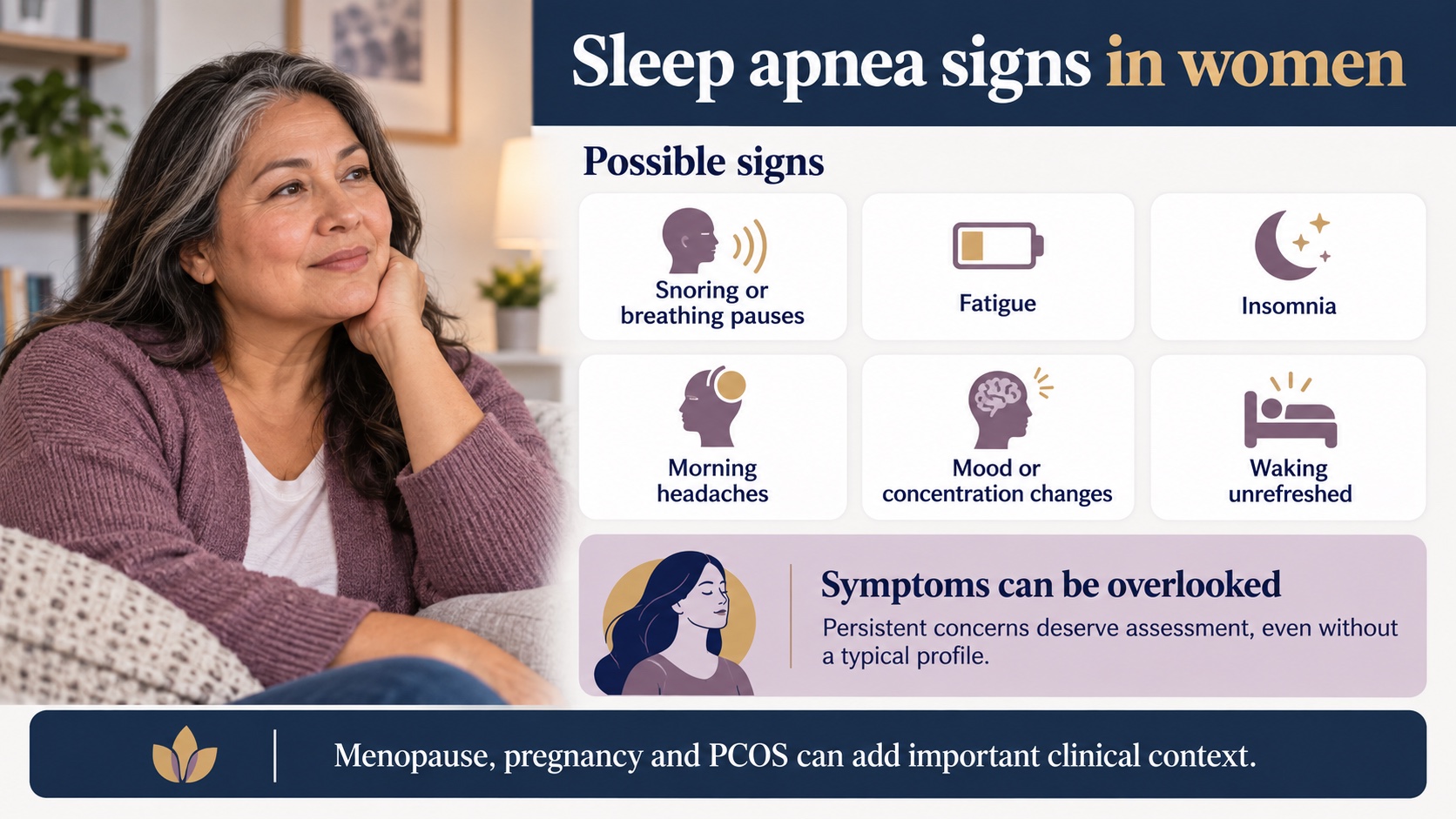
Women with sleep apnea may have classic signs such as snoring and witnessed pauses, but they may also report fatigue, insomnia, morning headaches, mood changes or waking unrefreshed. Symptoms can be less stereotypical, particularly around menopause, so persistent concerns should be assessed rather than dismissed because a person does not fit a typical profile.
At a glance
Key takeaways
Takeaway 1
Women can have classic signs such as loud snoring and witnessed pauses, but fatigue, insomnia and headaches may be more prominent.
Takeaway 2
Symptoms that overlap with stress, mood changes or menopause still deserve attention when they persist or affect daily function.
Takeaway 3
Obstructive sleep apnea becomes more common after menopause, while age, body composition and other health factors also influence risk.
Takeaway 4
PCOS is associated with a higher risk of obstructive sleep apnea, but symptoms and formal assessment—not PCOS alone—guide testing.
Takeaway 5
New snoring, breathing pauses, marked sleepiness or blood-pressure concerns during pregnancy should be raised promptly with the prenatal team.
Takeaway 6
A stereotype about who develops sleep apnea should never replace an individualized clinical assessment.
How symptoms may present
Women can have loud snoring and witnessed pauses, but may also report fatigue, insomnia, headaches, mood changes or waking unrefreshed.
Fatigue, insomnia and headaches
These symptoms are common and nonspecific, which can make the sleep-disordered breathing connection less obvious.
That overlap is important: fatigue, poor sleep, mood changes, and headaches have many possible causes. The useful question is not whether one symptom proves sleep apnea, but whether a pattern of nighttime disruption, daytime effects, risk factors, or a partner’s observations deserves a clinical conversation. A symptom record can help show what has changed and how it affects daily life.
Menopause and risk
Risk can rise after menopause, while age, hormonal changes, body composition and other factors may all contribute. A review of sex differences in obstructive sleep apnea describes how prevalence and presentation change across women’s life stages. Assessment should consider the whole health history.
Menopause can also bring insomnia, headaches, and fatigue on its own, which can make sleep-related breathing concerns easier to overlook. New or worsening snoring, witnessed breathing changes, waking unrefreshed, or daytime sleepiness are worth mentioning even if they occur alongside familiar menopause symptoms. The 2023 international evidence-based PCOS guideline advises healthcare professionals to assess symptoms of obstructive sleep apnea in women with PCOS and confirms that diagnosis requires a formal sleep study.
Pregnancy considerations
New snoring, witnessed pauses, high blood pressure or marked sleepiness during pregnancy should be discussed promptly with the prenatal care team.
Pregnancy can change the upper airway and breathing during sleep. A pregnancy-specific consensus guideline addresses screening, diagnosis and treatment of obstructive sleep apnea during pregnancy. Do not wait for a routine discussion if breathing changes, sleepiness, or blood-pressure concerns are new or worsening; raise them with the prenatal team so they can decide whether sleep assessment or other follow-up is appropriate. If someone already has diagnosed sleep apnea, pregnancy-related body changes can make it especially important to keep the prenatal and sleep-care teams informed.
Why recognition may be delayed
Stereotypes that sleep apnea only affects older men can contribute to missed or delayed assessment.
Prepare for an individualized assessment
Sleep apnea can affect women, and symptoms may include snoring or observed breathing pauses as well as fatigue, insomnia-like sleep disruption, morning headaches, mood changes, or daytime sleepiness. These symptoms overlap with many other conditions. They are reasons for a conversation and assessment, not proof of a diagnosis.
A clinician considers the complete history, relevant health factors, and appropriate testing. This approach avoids missing concerns because a person does not fit a stereotype about who has sleep apnea.
Describe changes in sleep, energy, headaches, concentration, snoring, or observed breathing. A change over time and its impact on daily function are useful clinical details for any person.
Consider bringing a short list of medicines, relevant health conditions, prior sleep-test results, and observations from a partner or household member. This helps the clinician look beyond a stereotype and choose an assessment approach that matches the individual situation.
Return to the Sleep Apnea Symptoms guide for the broader symptom picture, or compare the educational pathway for sleep apnea symptoms in men. These pathways help people find relevant information; they are not rigid categories and do not diagnose sleep apnea.
Common questions
Frequently asked questions
Can women have sleep apnea without loud snoring?
Yes. Snoring and witnessed pauses can occur, but some women report fatigue, insomnia-like sleep disruption, morning headaches, mood changes, or waking unrefreshed instead. Those symptoms still need clinical context because they can have many causes.
Can menopause make sleep apnea harder to recognize?
It can. Menopause may bring insomnia, headaches, and fatigue, while risk for sleep apnea can also increase during and after menopause. New breathing changes or ongoing daytime effects are worth discussing rather than assuming they are only menopause-related.
Should I mention new snoring during pregnancy?
Yes. New snoring, witnessed pauses, marked sleepiness, or blood-pressure concerns during pregnancy should be discussed promptly with the prenatal care team.
Is CPAP safe during pregnancy?
Positive airway pressure is an established treatment option for sleep apnea during pregnancy. The appropriate treatment and any adjustments should be managed with the prenatal and sleep-care teams.
What should I bring to an appointment about possible sleep apnea?
A short symptom timeline, observations from a bed partner, relevant health history and medicines, and any prior sleep-study reports can make the assessment more useful.
Teede HJ, et al. Recommendations from the 2023 International Evidence-based Guideline for the Assessment and Management of Polycystic Ovary Syndrome. https://pmc.ncbi.nlm.nih.gov/articles/PMC10477934/
Dominguez JE, et al. Society of Anesthesia and Sleep Medicine and the Society for Obstetric Anesthesia and Perinatology Consensus Guideline on the Screening, Diagnosis, and Treatment of Obstructive Sleep Apnea in Pregnancy. 2023. https://pmc.ncbi.nlm.nih.gov/articles/PMC10351908/
Next steps
Explore the Women’s Sleep Journey
Explore the Women’s Sleep Journey to organize your questions, then learn how home sleep testing works. A qualified health professional can help assess your symptoms and choose an appropriate next step.
To provide the best experiences, we use technologies like cookies to store and/or access device information. Consenting to these technologies will allow us to process data such as browsing behavior or unique IDs on this site. Not consenting or withdrawing consent, may adversely affect certain features and functions.
Functional
Always active
The technical storage or access is strictly necessary for the legitimate purpose of enabling the use of a specific service explicitly requested by the subscriber or user, or for the sole purpose of carrying out the transmission of a communication over an electronic communications network.
Preferences
The technical storage or access is necessary for the legitimate purpose of storing preferences that are not requested by the subscriber or user.
Statistics
The technical storage or access that is used exclusively for statistical purposes.The technical storage or access that is used exclusively for anonymous statistical purposes. Without a subpoena, voluntary compliance on the part of your Internet Service Provider, or additional records from a third party, information stored or retrieved for this purpose alone cannot usually be used to identify you.
Marketing
The technical storage or access is required to create user profiles to send advertising, or to track the user on a website or across several websites for similar marketing purposes.