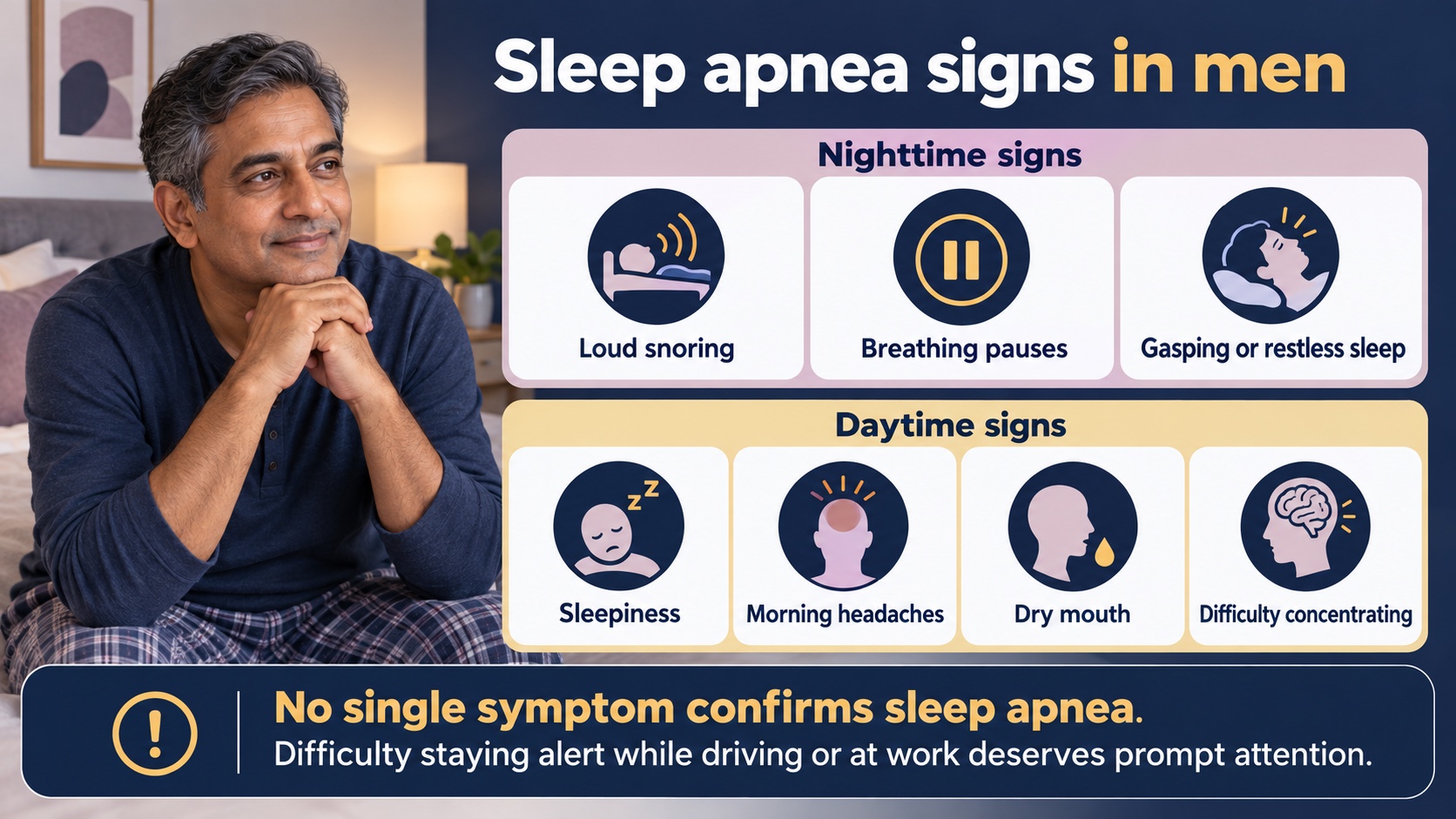
Common sleep apnea signs in men include loud snoring, witnessed breathing pauses, gasping, daytime sleepiness, morning headaches, dry mouth and difficulty concentrating. Research on sex differences in obstructive sleep apnea shows a male predominance in population and clinical samples, while women are often underdiagnosed. Symptoms still need a clinical assessment because snoring or fatigue alone cannot confirm sleep apnea.
At a glance
Key takeaways
Takeaway 1
Loud snoring, witnessed pauses and gasping are important nighttime signs, but no single symptom confirms sleep apnea.
Takeaway 2
Daytime sleepiness, morning headaches and concentration changes can be easier to recognize by their effect on daily function.
Takeaway 3
Body weight is one risk factor among several; age, family history and airway anatomy can also matter.
Takeaway 4
A partner’s observations can add useful context because the sleeper may not remember brief breathing changes.
Takeaway 5
Difficulty staying alert while driving or doing safety-sensitive work should never be normalized.
Takeaway 6
Diagnosis requires an appropriate sleep study interpreted with symptoms and health history.
Common nighttime signs
Frequent loud snoring, witnessed pauses, choking and restless sleep are common warning signs.
Those observations are useful because the sleeper may not remember every brief awakening or breathing change. They are still not a diagnosis: snoring and disrupted sleep can have more than one cause, and some people with sleep apnea do not have a classic snoring pattern. A bed partner’s description of what happens, how often, and whether there is gasping can provide helpful context at an assessment.
Daytime symptoms
Sleepiness, fatigue, morning headaches, dry mouth, irritability and concentration problems can follow disrupted sleep.
It can be hard to recognize gradual changes in alertness because people often attribute them to workload, stress, or getting older. Consider the functional effect: unintended dozing, trouble staying alert in meetings or while driving, reduced concentration, or waking feeling unrefreshed despite enough time in bed. These details help distinguish a general complaint of tiredness from a pattern that may warrant sleep assessment.
Risk factors and anatomy
Age, body weight, neck and airway anatomy, alcohol, smoking and family history can influence risk.
Risk factors are not a checklist for self-diagnosis. Some, such as age, family history, and airway anatomy, are not under a person’s control. Others, including alcohol and smoking, can affect breathing during sleep. The appropriate next step is to discuss the full pattern with a clinician, especially when symptoms or partner observations persist.
Work and driving safety
Men in safety-sensitive jobs should not normalize unintended sleep episodes or difficulty staying alert while driving.
Sleepiness can affect anyone, regardless of job title or how accustomed they are to demanding work. If staying alert behind the wheel, at height, around machinery, or in another safety-sensitive setting is difficult, avoid the unsafe task where possible and seek timely clinical advice. This is a safety decision, not a test of endurance.
Bring the full pattern to an assessment
Mention sleep schedule, observed breathing changes, daytime function, medicines, and relevant health history. This gives the clinician a more useful starting point than a single symptom alone.
If a partner or household member has noticed pauses, gasping, or unusually loud snoring, ask them to share what they observed. It can also help to note when daytime sleepiness occurs and whether it has affected driving, work, or concentration. The aim is not to collect perfect data; it is to give the clinician enough context to select and interpret an appropriate test.
No single sign proves or rules out sleep apnea, and these patterns are not rigid categories. Return to the Sleep Apnea Symptoms guide for the broader symptom picture, or compare the educational pathway for sleep apnea symptoms in women. A provider can determine whether home or laboratory testing is appropriate for the individual.
Common questions
Frequently asked questions
Does loud snoring mean I have sleep apnea?
No. Loud snoring is a common warning sign, but it does not confirm sleep apnea. A clinical assessment and an appropriate sleep study are used to diagnose the condition.
Can sleep apnea affect concentration or mood?
Disrupted sleep can affect alertness, attention, memory, and mood. These effects have many possible causes, so they should be considered alongside nighttime symptoms, health history, and formal assessment when needed.
What should a partner record or report?
Useful observations include loud snoring, pauses in breathing, gasping, frequent awakenings, and how often the pattern seems to occur. A partner does not need to diagnose the problem; a clear description is enough.
Does being fit rule out sleep apnea?
No. Body weight is one risk factor, but airway anatomy, age, family history, health conditions, and lifestyle factors can also influence risk. Symptoms still deserve assessment when they persist.
What if sleepiness is affecting my work or driving?
Do not normalize unintended sleep episodes or difficulty staying alert during safety-sensitive tasks. Avoid driving or other unsafe activity when dangerously sleepy and arrange timely clinical follow-up.
Explore the Men’s Sleep Journey to organize your questions, then learn how home sleep testing works. A qualified health professional can help assess your symptoms and choose an appropriate next step.
To provide the best experiences, we use technologies like cookies to store and/or access device information. Consenting to these technologies will allow us to process data such as browsing behavior or unique IDs on this site. Not consenting or withdrawing consent, may adversely affect certain features and functions.
Functional
Always active
The technical storage or access is strictly necessary for the legitimate purpose of enabling the use of a specific service explicitly requested by the subscriber or user, or for the sole purpose of carrying out the transmission of a communication over an electronic communications network.
Preferences
The technical storage or access is necessary for the legitimate purpose of storing preferences that are not requested by the subscriber or user.
Statistics
The technical storage or access that is used exclusively for statistical purposes.The technical storage or access that is used exclusively for anonymous statistical purposes. Without a subpoena, voluntary compliance on the part of your Internet Service Provider, or additional records from a third party, information stored or retrieved for this purpose alone cannot usually be used to identify you.
Marketing
The technical storage or access is required to create user profiles to send advertising, or to track the user on a website or across several websites for similar marketing purposes.