
Sleep health education
Understanding AHI and Sleep Study Results

Quick answer
The apnea-hypopnea index, or AHI, is the average number of apneas and hypopneas recorded per hour of sleep during a polysomnogram. Home tests may report a respiratory event index based on recording time rather than confirmed sleep time. A single number does not capture every aspect of severity; symptoms, oxygen patterns, health history and test quality also matter.
Understanding AHI and your sleep test results
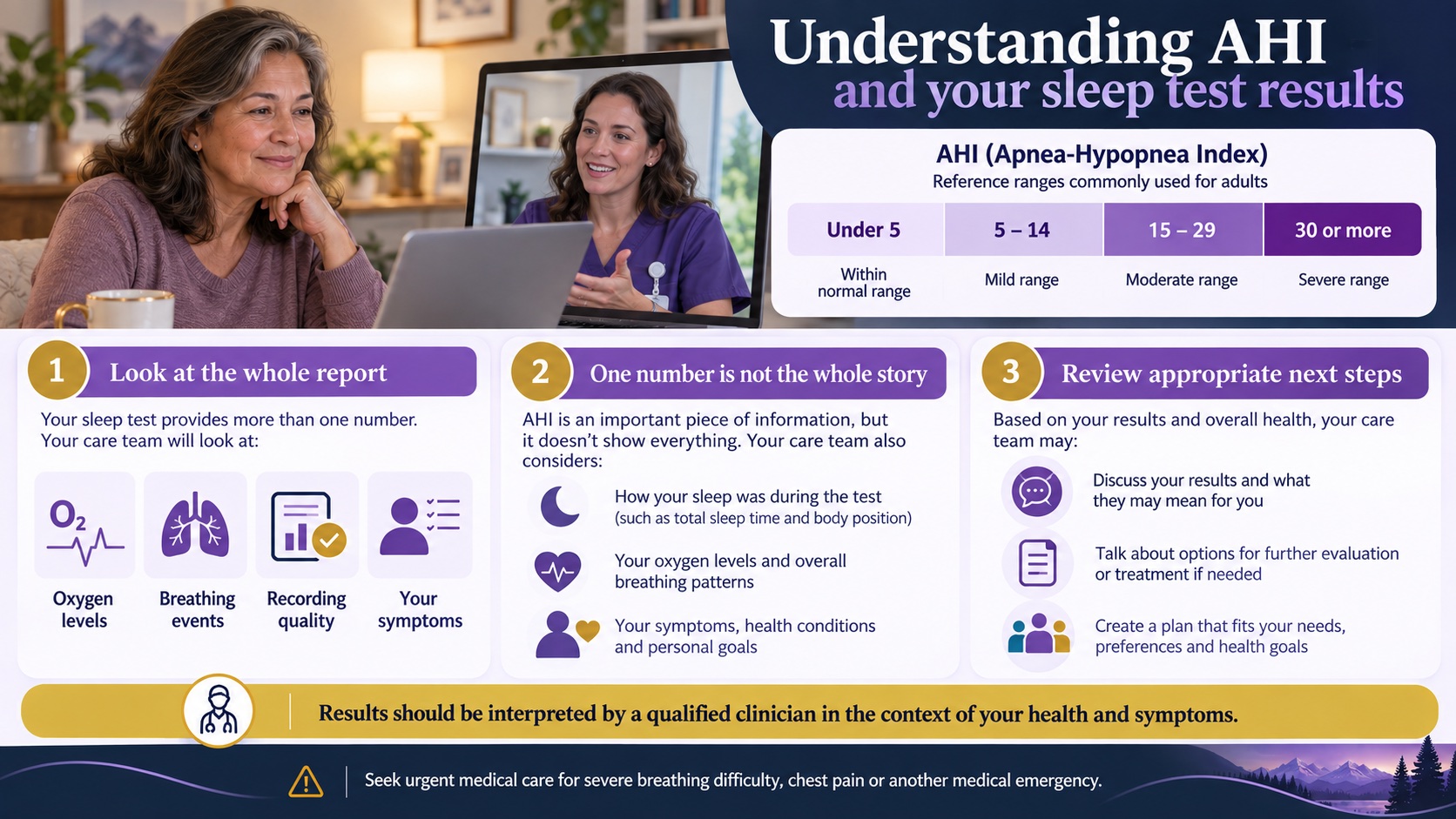
- AHI under 5, 5–14, 15–29 and 30 or more are commonly described ranges.
- AHI is one part of the report; oxygen levels, symptoms, recording quality and health history also matter.
- A qualified clinician should explain the results and appropriate next steps.
Expert perspective
A result should be interpreted together with symptoms, health history and recording quality. The number helps describe what was measured, but the next step comes from the full clinical picture.
What AHI means
AHI is the number of apneas plus hypopneas divided by hours of confirmed sleep. It is one measure used to describe OSA frequency in a laboratory study.
An apnea is a pause in breathing; a hypopnea is a partial reduction in breathing that meets the study’s scoring rules. AHI turns those scored events into a rate so results can be discussed consistently. It does not tell a visitor exactly how they felt during the night, how restorative sleep was, or what caused every awakening.
Your AHI can change from night to night. Research following people over many nights shows your AHI can shift enough between nights to move you into a different severity category, especially if your sleep apnea is mild or moderate. That is why a result from several nights, interpreted by a sleep physician, is more dependable than one night alone. It is also why a result near a category boundary (for example, an AHI of 14 or 16) should be read with care. See can one night of testing miss sleep apnea?
AHI severity categories
For adults, sleep apnea severity is commonly grouped by the number of apneas and hypopneas per hour of sleep:
| AHI (events per hour) | Category |
|---|---|
| Fewer than 5 | Within the normal range |
| 5 to fewer than 15 | Mild |
| 15 to fewer than 30 | Moderate |
| 30 or more | Severe |
Home sleep test reports often apply the same bands to the respiratory event index (REI). Because REI divides by recording time rather than sleep time, it can underestimate severity. Children are assessed with different, lower thresholds. The reviewing clinician confirms which cut-points apply to your report (Sleep Foundation).
Categories are a shared clinical shorthand, not a substitute for the full report. Two people can have a similar index but different symptom burden, oxygen patterns, underlying conditions, or confidence in the data. A useful results conversation therefore starts with the number and then asks what it means for that individual.
Symptoms, cardiovascular risk, sleepiness, event type, oxygen burden and test quality can all be clinically important even when two people have the same AHI.
AHI versus REI
Home studies may use recording time rather than measured sleep time, producing a respiratory event index. This can affect the apparent event rate.
For example, time spent awake while the device is recording may be included in the denominator for an REI. Because someone is not necessarily asleep for all of that time, an REI and a laboratory AHI are not interchangeable measures. The report should identify which measure was used; the ordering clinician can explain what it can and cannot show.
AHI and REI worked example
Suppose a laboratory study reports an AHI of 12 events per hour of confirmed sleep, while a home study on another night reports an REI of 8 events per hour of recording time. That difference does not automatically show improvement: the tests may have used different denominators, captured different amounts of sleep and recorded different nights. A clinician would review the test type, usable data, symptoms and oxygen findings before interpreting the two numbers together.
For a deeper explanation of how home-test design and recording time can affect results, read How Accurate Are Home Sleep Tests?.
Oxygen and other results
Reports may include oxygen desaturation, lowest oxygen level, snoring, body position, pulse and signal quality. Some reports also list an oxygen desaturation index, or ODI—the number of qualifying oxygen drops per hour according to the report's scoring method. These measures provide additional context, and ODI should be interpreted with the definition and threshold used by that testing service.
It is useful to ask whether events clustered in a particular sleep position or part of the night, but not to draw a treatment conclusion from one field alone. Signal quality and the amount of usable data also matter. When a report is technically limited, the question is not whether to ignore symptoms; it is what follow-up will produce a dependable answer.
Questions to ask about your report
Ask the reviewing clinician:
- Is the index based on confirmed sleep time or recording time?
- Was the study technically adequate, with enough usable data?
- Were the breathing events obstructive, central or mixed?
- What do the oxygen measures—including ODI, if reported—show?
- Did body position or another part of the recording affect the result?
- Does the result fit the symptoms and reason for testing?
- What follow-up is recommended?
Reading a report without self-diagnosing
AHI is an index used in sleep-study reporting; it is not a complete description of a person’s health, sleep quality, or treatment needs. The meaning of a result depends on the type and adequacy of the study, symptoms, oxygen data, sleep time, other conditions, and the clinician’s interpretation. Ask the ordering clinician to explain the terms used in the report and how the result fits the original reason for testing.
Do not change treatment, settings, or follow-up plans based only on a number. If symptoms persist despite a reassuring result, or if a study was technically inadequate, further evaluation may be appropriate.
Learn more about the full clinical pathway in How Sleep Apnea Is Diagnosed.
Choose your next step
Complete guide: Home Sleep Test