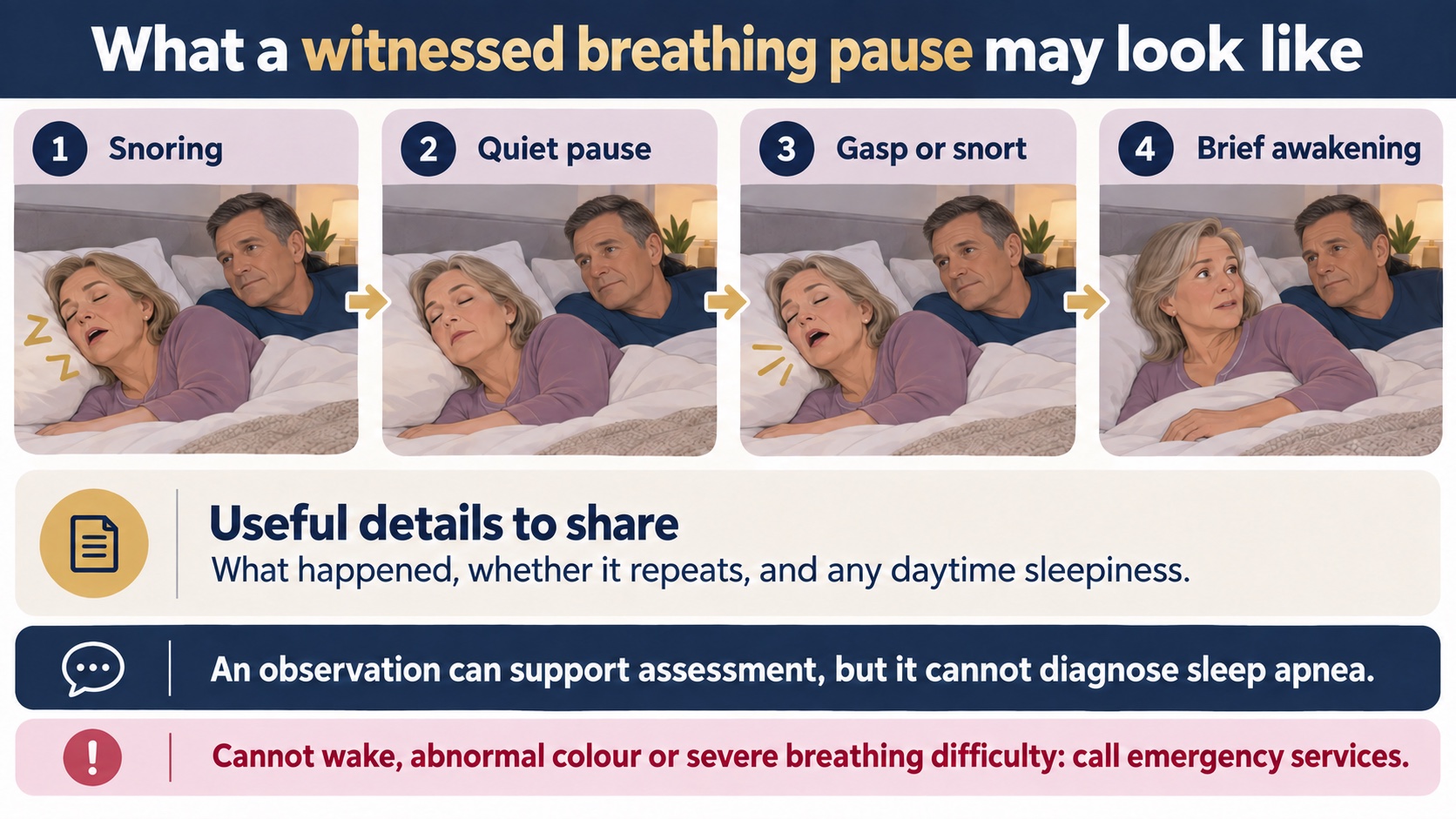
Witnessed breathing pauses are episodes in which a bed partner notices that breathing becomes very shallow or appears to stop during sleep, often followed by a snort, gasp or brief awakening. This is an important warning sign of sleep apnea and should be discussed with a healthcare provider, particularly when daytime sleepiness or loud snoring is also present.
At a glance
Key takeaways
Takeaway 1
Repeated pauses followed by gasping or snorting are important observations to share, but they do not diagnose sleep apnea.
Takeaway 2
A brief, respectful description of the pattern and daytime effects is more useful than repeated monitoring at home.
Takeaway 3
Inability to wake the person, abnormal colour or severe breathing difficulty requires emergency help.
What a witnessed apnea looks like
A partner may notice a period of silence or little visible airflow, followed by a gasp, snort, body movement or brief awakening. The cycle can repeat throughout the night.
Why partners notice first
The sleeper may not fully awaken or remember the event, so partner observations are often important in the clinical history.
What information to record and share
Describe the pattern in plain language: whether there is snoring, silence, gasping, choking, restless sleep or repeated awakenings. Note whether it happened once or recurs across a night or on different nights, and whether the person has daytime sleepiness, morning symptoms or safety concerns. Medicines, alcohol or sedative use and relevant medical history can also help the clinician understand the context.
There is no observation-based number of pauses that confirms sleep apnea. A repeated pattern—especially with gasping, loud snoring, daytime sleepiness or other symptoms—is worth raising without waiting to count an exact number or duration.
How this differs from normal variation
Breathing can vary during sleep, but repeated obvious pauses, gasping or colour change should not be dismissed.
Testing and diagnosis
A provider must evaluate the full history and choose an appropriate sleep study. A recording made by a partner is not a diagnostic test.
Call emergency services if a person is not breathing normally, cannot be awakened, has blue or grey colour, severe breathing difficulty or another emergency sign.
From observation to assessment
Breathing observations can be an important reason to discuss testing, particularly when they occur with daytime sleepiness or other symptoms. The right next step depends on the whole clinical picture. A qualified clinician can decide whether testing is appropriate, explain the limits of a home test, and interpret any result in context.
Keep observations respectful and useful
A brief description is usually more helpful than repeated monitoring. Share only information relevant to the clinical conversation, and prioritize the sleeper’s privacy and safety.
Common questions
Frequently asked questions
How many breathing pauses per night are concerning?
There is no number a partner can count that confirms sleep apnea. Repeated obvious pauses, especially with gasping, snoring or daytime sleepiness, are worth discussing with a healthcare provider.
Can I record my partner to show a clinician?
A short recording may provide context, but it is not a diagnostic test. Respect the sleeper’s consent and privacy, and do not delay urgent help to make a recording.
Are witnessed pauses always obstructive sleep apnea?
No. An observation cannot identify the cause or type of breathing event. A qualified clinician and appropriate testing are needed.
What if the pauses happen only on some nights?
Sleep position, alcohol, congestion and other factors can change what a partner notices. An intermittent but recurring pattern is still useful to report.
Should I time or count every pause?
No. A general description of whether the pattern repeats, what happens before and after it, and any daytime effects is usually more useful than prolonged monitoring.
Should I wake someone if I notice a breathing pause?
If you believe the person is in immediate danger, cannot be awakened, or has severe breathing difficulty or concerning colour change, seek emergency help. For recurring non-emergency observations, discuss the pattern with a healthcare professional rather than relying on repeated waking as an assessment strategy.
What details are most helpful to share?
Describe what you observed: snoring, silence, gasping, choking, body movement, how often it seems to happen, and daytime effects such as sleepiness. A brief description can be more useful than trying to estimate a diagnosis.
To provide the best experiences, we use technologies like cookies to store and/or access device information. Consenting to these technologies will allow us to process data such as browsing behavior or unique IDs on this site. Not consenting or withdrawing consent, may adversely affect certain features and functions.
Functional
Always active
The technical storage or access is strictly necessary for the legitimate purpose of enabling the use of a specific service explicitly requested by the subscriber or user, or for the sole purpose of carrying out the transmission of a communication over an electronic communications network.
Preferences
The technical storage or access is necessary for the legitimate purpose of storing preferences that are not requested by the subscriber or user.
Statistics
The technical storage or access that is used exclusively for statistical purposes.The technical storage or access that is used exclusively for anonymous statistical purposes. Without a subpoena, voluntary compliance on the part of your Internet Service Provider, or additional records from a third party, information stored or retrieved for this purpose alone cannot usually be used to identify you.
Marketing
The technical storage or access is required to create user profiles to send advertising, or to track the user on a website or across several websites for similar marketing purposes.